S.T. Dupont Lighter Maintenance Guide: Refill, Flint, Flame, Cleaning and Repair
How to look after an S.T. Dupont lighter, model by model: the right gas and flint, setting the flame on a Ligne 1, Ligne 2 or Gatsby, cleaning lacquer and plating, storage, and when it needs a service.
By Max Meijster Updated 15 October 2026 10 min read

An S.T. Dupont lighter is made to be used every day for decades, and most of the vintage pieces that come through our workshop still work the way they did when they left Faverges. What keeps them that way is simple care: the right gas and flint, a flame that is set correctly, a soft cloth for the finish, and a proper service when something stops working.
This guide covers all of it for the Ligne 1, Ligne 2, Gatsby, Line D, Soubreny and Urban. The basics are the same for every model. Where they differ, the table and the model sections show you what to do on yours.
Your model at a glance
Gas, flint and flame control for the S.T. Dupont flint lighters we see most. Not sure which model you have? Our guide to every S.T. Dupont model shows them side by side.
| Model | Gas refill | Flint | Flame adjustment |
|---|---|---|---|
| Ligne 1 BS | yellow (small), red (large) | Black | None on the lighter: set at the burner nozzle, by a specialist |
| Ligne 1 BR | yellow (small), red (large) | Black | Wheel under the lid, near the hinge |
| Soubreny | blue | Black | Wheel under the lid, near the hinge |
| Ligne 2 | yellow (regular), green (small) | Black | Adjuster on the base: lift its lip with a fingernail, then turn |
| Gatsby | green | Black | Adjuster on the base: lift its lip with a fingernail, then turn |
| Line D | blue | Red | Adjuster on the base: lift its lip with a fingernail, then turn |
| Urban | blue | Black | Slider on the top |
Refilling with the right gas
Every S.T. Dupont takes one colour of S.T. Dupont gas, and the refill nozzles are shaped for their own valves. The refill valve sits on the bottom of the lighter under a cap. On most lighters you lift the small lip of the cap and turn it out; only the oldest, early Ligne 1 models among them, have a slotted cap that you turn with a coin. A colour dot inside the cap shows the gas to buy. No dot means the cap was replaced at some point, nothing more.
- Turn the flame to minimum. S.T. Dupont advises this before every refill on models with a flame adjuster.
- Open the cap. Lift the lip and turn it out, or use a coin on the oldest models.
- Hold both upside down. The lighter with the valve up, the can vertical above it, nozzle down.
- Press for about three seconds at a time. Press firmly, without forcing; S.T. Dupont’s own manual gives three presses of about three seconds each. Stop when the gas stops flowing.
- Wait a few minutes. Let the gas settle and any gas on the outside evaporate, wipe the lighter, then set the flame back to normal and light it.
Refill in a well aired room, away from any flame. If the flame jumps, changes height or the lighter pops when you light it, there is probably air in the tank: bleed it and refill. Our S.T. Dupont gas refill guide has the full colour chart and explains how to bleed the tank safely.
Lighters are shipped empty, as transport rules require. Every lighter we sell is bled after its service, so your first refill goes into a clean tank.
Changing the flint
When the wheel turns but gives no sparks, or only weak ones, the flint is worn. On a lighter that has sat in a drawer for years, an old flint can also crumble or get stuck in its tube.
S.T. Dupont makes its flints in colours, like its gas. Use the original flints: dealers who service these lighters warn that generic flints can wear the flint wheel over time.
| Flint | Lighters |
|---|---|
| Black (900600) | Ligne 1, Ligne 2 (both sizes), Gatsby, Soubreny, Urban, Jeroboam and long table lighters |
| Red (900650) | Line D (Ligne D), Ligne 8, Liberté, Mon Dupont |
How to change the flint on a Ligne 1, Ligne 2, Gatsby, Line D or Soubreny
Work over a table or a tray: once the slide is out, the flint wheel comes loose and it is small.
- Open the lid. On a Ligne 1 BS, first close the gas with the small shutoff wheel inside the lid.
- Release the slide. Push the small pin on the flint holder down with your fingernail. The slide moves backwards.
- Take out the slide and the wheel. Pull the slide gently back and lift out the flint wheel.
- Remove the old flint. Turn the lighter over so the old flint and any crumbs fall out.
- Insert the new flint. Put it in the channel against the flint wheel.
- Close it again. Slide the holder back with the pin down until it clicks into place. On a Ligne 1 BS, open the gas again.
On the Urban the flint sits inside the flame tube on the top of the lighter, under a small screw. Press the screw in and turn it a little to the left, and it comes out. Drop in the new flint, put the screw back, press it in and turn it a little to the right.
Adjusting the flame
A good flame is calm and upright and stays the same height every time you light it. The right height depends on the lighter, but with the lid open the flame should never rise above it. Adjust in small steps and test after each one. If the flame stays low with the adjuster fully open, the lighter is short of gas, has air in the tank or needs new seals: turning further will not help.
Ligne 1 BR and Soubreny: the wheel under the lid

- Flame control
- Small notched wheel under the lid, near the hinge
- Lower
- Turn clockwise
- Higher
- Turn anticlockwise
- Gas
- yellow (small), red (large); Soubreny blue
The notched wheel sits under the lid, close to the hinge. Turn it with a fingertip: clockwise for a lower flame, anticlockwise for a higher one. If the wheel resists, do not force it. A stiff wheel or a flame that will not stay where you set it is a job for a workshop. The story of this model is in the history of the Ligne 1.
Ligne 2, Gatsby and Line D: the adjuster on the base
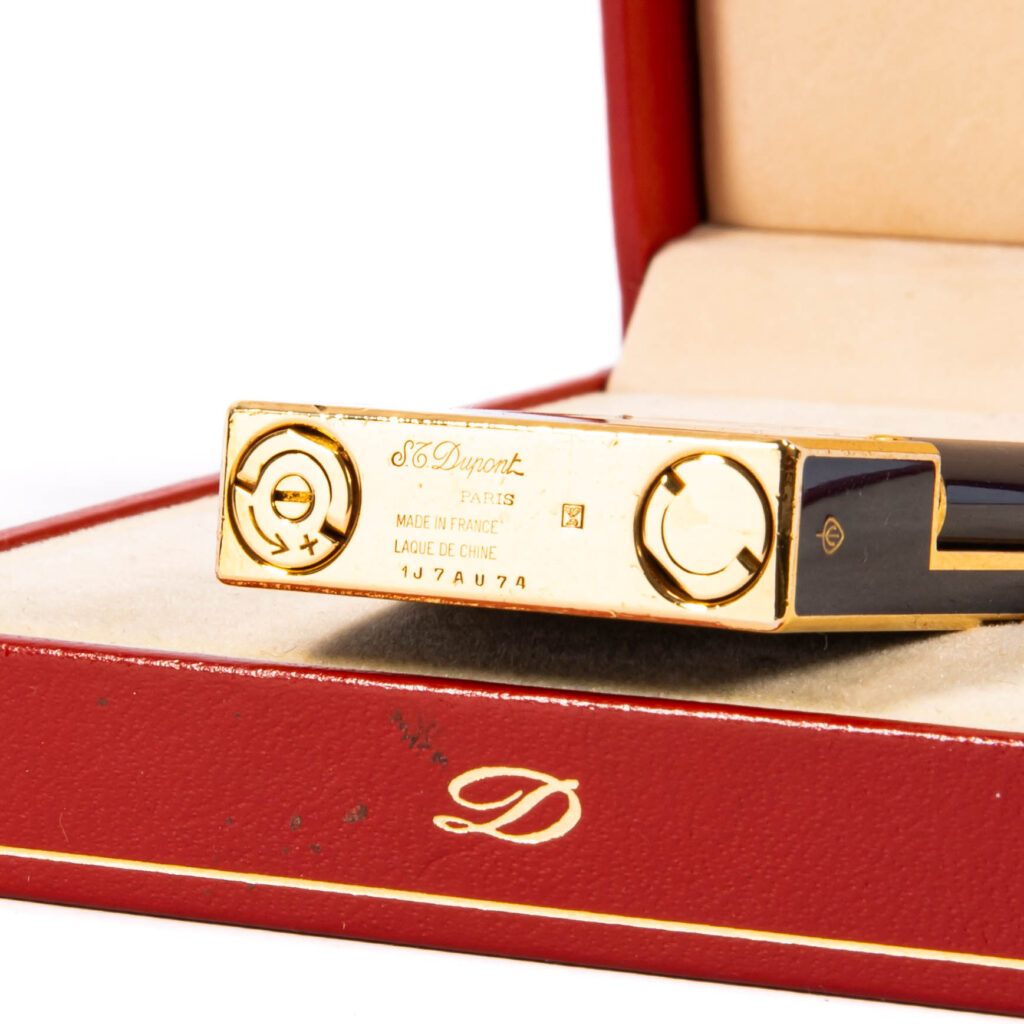
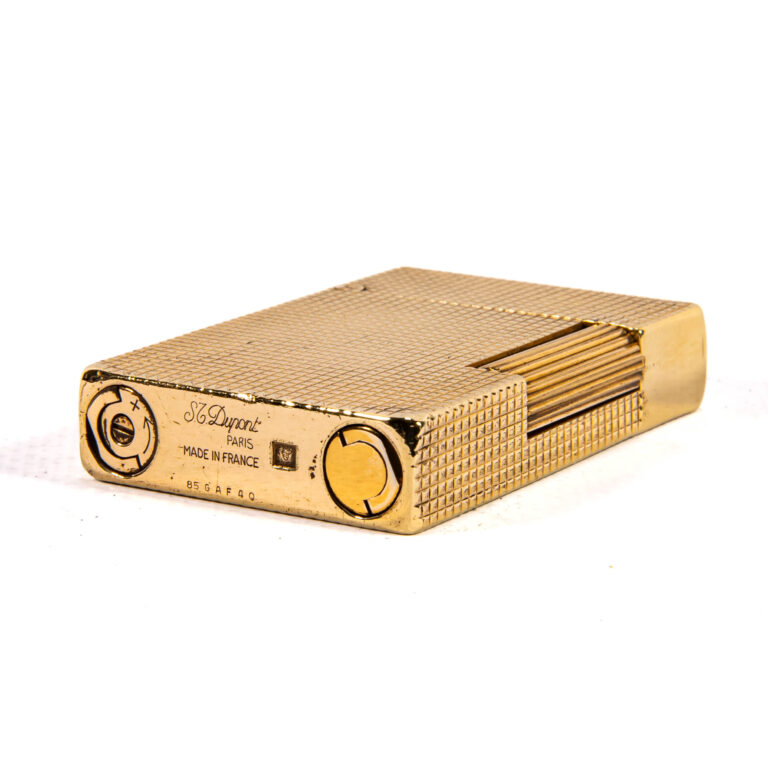
These models have two openings in the base: the refill cap and, beside it, the round flame adjuster. The adjuster has a small lip: lift it out with your fingernail, then turn it. Clockwise gives a lower flame, anticlockwise a higher one, or simply follow the arrow on the adjuster. Turn a little at a time and test the flame after each turn. The adjuster only needs turning: do not try to take it out, certainly not while the lighter holds gas.

- Flame control
- Round adjuster in the base, beside the refill cap: lift its small lip with a fingernail, then turn
- Lower
- Clockwise
- Higher
- Anticlockwise, or follow the arrow
- Gas
- Ligne 2 yellow, small Ligne 2 and Gatsby green, Line D blue
Ligne 1 BS: no adjuster

- Flame control
- None on the outside; set at the square brass burner nozzle
- Gas
- yellow (small), red (large)
- Made
- 1959 to 1973
The BS, the earliest Ligne 1, has no flame wheel or screw. The height is set by turning the square brass nozzle where the gas comes out, with a special tool. It takes care: the finish around the nozzle scratches easily and too much force can damage the valve. If the flame on your BS is clearly wrong, we recommend leaving it to a workshop.
Do not twist the nozzle of a BS unless you know exactly what you are doing. Turned the wrong way it can snap off, and then the lighter needs a service. Bring it to a specialist.
Urban: the slider on the top

- Flame control
- Slider on the top of the lighter
- Gas
- blue
- Flint
- Black, inside the flame tube under a small screw
The Urban has a design of its own, with the flame set by a slider on the top instead of a wheel or an adjuster in the base. Move it a little at a time and test the flame after each change.
Cleaning lacquer, plating and silver
For every finish the rule is the same: a soft, clean cloth, and no solvents. Never use metal polish on lacquer or plating. Wipe the lighter after every refill, because gas on the surface attracts dust.
Never use a liquid polish such as Silvo on a lighter. It seeps into the seams and the mechanism and does more harm than good: we see it often in lighters that come in for repair. To shine a lighter, use a jeweller’s cloth.
| Finish | How to clean it |
|---|---|
| Chinese lacquer (Laque de Chine) | Treat it like a spectacle lens, as S.T. Dupont puts it: breathe on it or mist it lightly, then wipe with a soft cloth. No polish, no solvents. |
| Gold or palladium plating | A dry microfibre or jeweller’s cloth. Plating is a layer of precious metal over brass: polish and silver dip wear it through. Palladium does not tarnish, so it only needs wiping. |
| Silver | A silver polishing cloth. Silver darkens naturally over time, and faster when it stays in contact with leather or rubber. |
| Engine turned patterns | Dust in the fine lines comes out with a soft, dry brush before you wipe the lighter. |
| Solid gold | A soft cloth is enough. More on these pieces in our guide to S.T. Dupont solid gold lighters. |

- Finish care
- Silver: a silver polishing cloth; keep it away from leather and rubber
- Gas
- blue
- Flint
- red
Worn plating cannot be polished back. S.T. Dupont itself offers gold or silver replating for the Ligne 1, Ligne 2 and Line D, but not for lacquer pieces.
Storing your lighter
- Keep it cool and out of the sun. S.T. Dupont warns never to expose a lighter to more than 50°C or to sunlight for a long time. A car dashboard or a sunny windowsill is the wrong place.
- Store it with gas, without the flint. Gas in the tank is better for the valve, so there is no need to empty a lighter you put away. Take the flint out, though, so it cannot crumble or get stuck in its tube.
- Keep it apart. Store it in its box or a soft pouch, away from keys and coins that scratch.
- Silver away from leather and rubber. Long contact speeds up tarnishing.
- Use it now and then. A lighter that sits unused for years tends to dry out its seals.
Travelling with it? Read can I bring an S.T. Dupont lighter on a plane before you pack.
When your S.T. Dupont needs a service or repair
Gas, flint and flame are yours to look after. Inside the lighter, the valve, seals and gas regulator are workshop work. S.T. Dupont’s own advice is not to adjust the lighter except with the mechanisms made for it. Have it serviced when:
- You smell gas or hear a hiss with the lid closed. Stop using it.
- It empties within days without being used: a seal is leaking.
- The flame stays low or unstable after bleeding, refilling with the right gas and adjusting.
- There is no spark even with a new flint.
- The lid does not close or lock properly, or the hinge has play.
- It has not been used for years. Old gas and dried seals usually need attention before it holds gas again.
What a service includes
S.T. Dupont’s own after sales service offers a revision (the internal parts such as valve, regulator and seals, plus cleaning and a leak and function test) and a restoration, which adds new external parts and polishing. Repairs carry a twelve month guarantee. For models older than ten years the house warns that parts may no longer be available. Its jet lighters, among them the Minijet, Maxijet, Slim 7 and Défi Extrême, are not repaired but replaced.
Every lighter we sell is checked, cleaned and serviced in our workshop before it is listed, and bled after its service. For a lighter bought elsewhere, get in touch and we will tell you honestly whether a service is worth it. Buying a vintage piece? Check it first with our guide on how to spot a fake S.T. Dupont: no workshop services a counterfeit.
Looking for one that is ready to use? Browse our vintage Ligne 1 lighters and vintage Ligne 2 lighters, each one serviced in our workshop.
Serviced vintage S.T. Dupont lighters
See all S.T. Dupont
Questions collectors ask
Where can I have my S.T. Dupont lighter repaired?
S.T. Dupont's after sales service, through its boutiques, offers a revision and a full restoration; for vintage models parts may no longer be available. We service every lighter we sell, and for others you can ask us whether a service is worth it.
How do I adjust the flame on an S.T. Dupont Ligne 2?
Lift the small lip of the round adjuster in the base, next to the refill cap, with your fingernail and turn it: clockwise for a lower flame, anticlockwise for a higher one, or follow the arrow on the adjuster. The Gatsby and Line D work the same way.
How do I adjust the flame on an S.T. Dupont Ligne 1?
On a Ligne 1 BR, turn the small notched wheel under the lid, near the hinge: clockwise lowers the flame, anticlockwise raises it. The older Ligne 1 BS has no adjuster; its flame is set at the burner nozzle, which can snap off if turned wrongly, so leave it to a specialist.
Which flint does an S.T. Dupont lighter take?
The black S.T. Dupont flint fits the Ligne 1, Ligne 2, Gatsby, Soubreny and Urban. The red flint is for the Line D, Ligne 8, Liberté and Mon Dupont.
Why does my S.T. Dupont spark but not light?
Usually it is out of gas or has air in the tank. Bleed it, refill with the right colour gas, wait a few minutes and try again; if it still fails, it needs a service.
How do I clean a lacquer S.T. Dupont lighter?
Like a spectacle lens: breathe on it or mist it lightly and wipe with a soft cloth. Never use solvents, metal polish or a liquid polish such as Silvo on a lighter.
Sources and further reading
- S.T. Dupont: lighter refills and flints gas and flint colour per model (black flint 900600, red flint 900650)
- S.T. Dupont: lighter care cleaning lacquer and silver, no solvents, silver and leather or rubber
- S.T. Dupont: after sales service revision, restoration, replating, non repairable jet models, parts for models over ten years
- S.T. Dupont: Ligne 2 user manual refilling, changing the flint, safety warnings
- Artbrown: S.T. Dupont Ligne 2 refills, maintenance and tips flame screw direction, original flints