Original S.T. Dupont Maki-e or Aftermarket Work: How to Tell the Difference
Many maki-e S.T. Dupont lighters offered online are original lighters with aftermarket decoration, sold at the price of factory work. Five checks show the difference.
By Max Meijster Updated 15 October 2026 10 min read
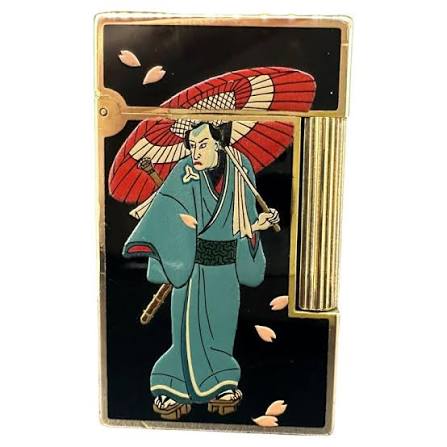
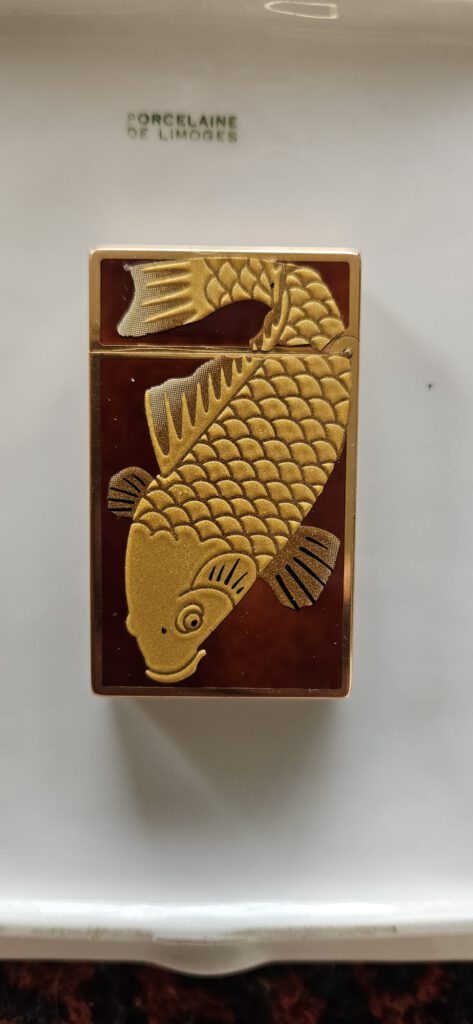
Search eBay for S.T. Dupont lighters and you will find them: a Ligne 2 with a golden koi across the front, a samurai under a red parasol, a pair of cranes on a Ligne 1, all listed as original S.T. Dupont maki-e and usually at a price that seems too good to be true. In most cases the lighter itself is an original S.T. Dupont. The maki-e is not: it was added after the lighter left the factory, very often as a printed sticker over the ordinary lacquer. Sold as original, such lighters are often called fake maki-e. We call the decoration what it is: aftermarket work.
That matters, because the usual checks from our guide on how to tell whether an S.T. Dupont lighter is authentic (serial number, engraving, weight, the cling) will often pass, simply because the lighter underneath is original. To tell original maki-e from aftermarket work you have to look at the maki-e itself. Here is what an original piece is, and five checks that show quickly which one is in front of you.
This guide is not about commissioned aftermarket maki-e. Some collectors have an artist decorate their original S.T. Dupont with maki-e on top of the factory lacquer. Done by a skilled hand, that is fine craftsmanship and a lighter worth owning for what it is. This guide is about something else: sellers who present aftermarket maki-e as original S.T. Dupont work and ask the price of an original.
The checks at a glance
- Model and years: did S.T. Dupont make maki-e on this model, in this lacquer colour and in this design?
- The lacquer base: an original picture lies within the lacquer, smooth and level, and ends exactly at the gold trim.
- Signature and number: the artist’s seal, signature and number belong inside the lacquer, and a seal alone proves nothing.
- Papers and box: a seller who claims an original should be able to show the artist’s papers and a box for this model.
- Price and seller claims: the price of an original needs proof; a low price or no photos from the side and the base is a warning.
What is an original S.T. Dupont maki-e lighter?
Maki-e is a Japanese lacquer technique that took shape in the Heian period, more than a thousand years ago. The name means “sprinkled picture”: the artist draws the design with a fine brush in wet lacquer, then sprinkles gold or silver powder onto it before it dries. There are three main styles. In flat hira maki-e the powder is sealed and polished. In raised taka maki-e the design is built up first. In togidashi maki-e the design is covered with more lacquer and polished back until the gold appears level with the surface. Maki-e is often combined with raden, inlaid shell, and rankaku, inlaid eggshell.
S.T. Dupont’s vintage maki-e lighters were never production pieces in the usual sense. They were made to order. The customer paid in advance, and S.T. Dupont made a Line D or Soubreny lighter with gold trim and black Chinese lacquer.
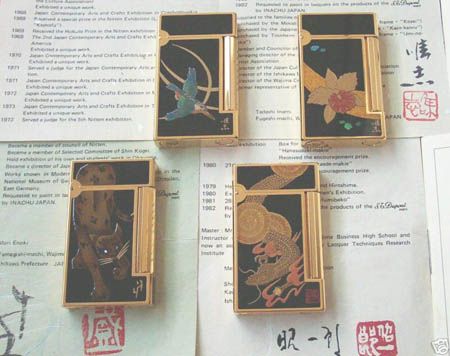
That lighter went to Japan, where a master craftsman applied the design in lacquer with 24 carat gold powder, eggshell or mother of pearl, layer by layer, polishing and reapplying until it was finished. Each lighter took three to four months. Every piece is signed by both S.T. Dupont and the Japanese artist and carries a serial number inscribed by the artist, and because each was made by hand, no two are exactly alike, even within one design.
S.T. Dupont still makes maki-e lighters today, as a separate collection on the Ligne 2 and the larger Le Grand, decorated in Japan by the workshop Wajimaya Zenni and signed Zenni on the reverse. Designs include dragons and a samurai. These are sold new through S.T. Dupont’s boutiques and dealers at several thousand euros each.
So in this guide “original” means maki-e made through S.T. Dupont itself: the vintage made to order programme or the current Zenni collection. Whatever the model, one thing is true of every original piece: the picture is part of the lacquer, not something sitting on top of it. Nearly every check below comes back to that. More about the models in our guide to every S.T. Dupont model, and about other rare pieces in our guide to S.T. Dupont limited editions.
Aftermarket maki-e, and why some is sold as original
Aftermarket maki-e is any maki-e decoration, hand made or printed, added to an S.T. Dupont after it left the factory and outside S.T. Dupont’s own programme. That covers very different things. At one end is a piece a collector commissioned from a lacquer artist, sold honestly as what it is. At the other end is a printed sticker.
The aftermarket pieces we see offered as original most often start as original S.T. Dupont lighters, usually a Ligne 2 or Ligne 1 in plain lacquer. A printed sticker goes on the front, and sometimes the back. Some are made simply to make an ordinary lighter look more valuable than it is. Others serve a less innocent purpose: a sticker is an easy way to hide chips, cracks or wear in the lacquer underneath.
That is why we think a sticker sold as maki-e lowers a lighter’s value rather than adding to it. You pay more for a piece whose actual condition you cannot see. At best there is a perfectly good lacquered S.T. Dupont underneath; at worst, the damage the sticker was chosen to cover. Note that aftermarket maki-e is not the same as a counterfeit, a lighter S.T. Dupont never made at all; for those, see why you should avoid counterfeit Dupont lighters.
Check 1: the model and years
The quickest check needs no loupe at all. Original vintage maki-e was made on the Line D and the Soubreny, from about 1989 until 2003, in black Chinese lacquer and a limited number of known designs. Original modern maki-e is on the Ligne 2 and Le Grand, in the designs of S.T. Dupont’s current collection. Compare the listing with that before you look at anything else.
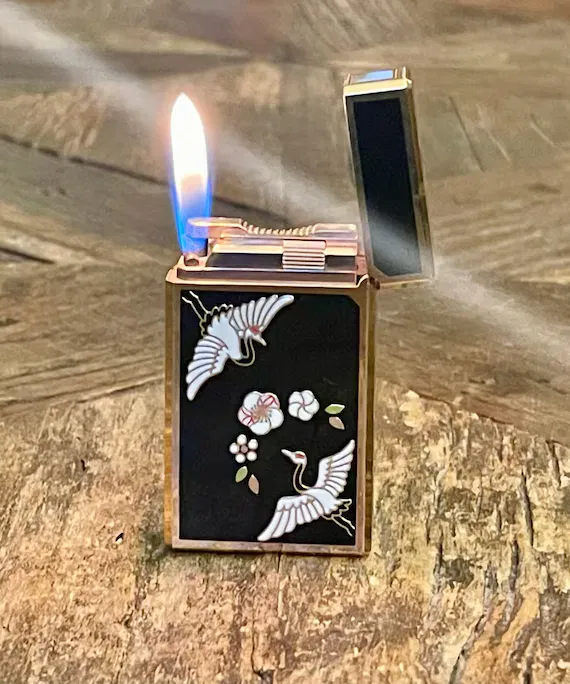
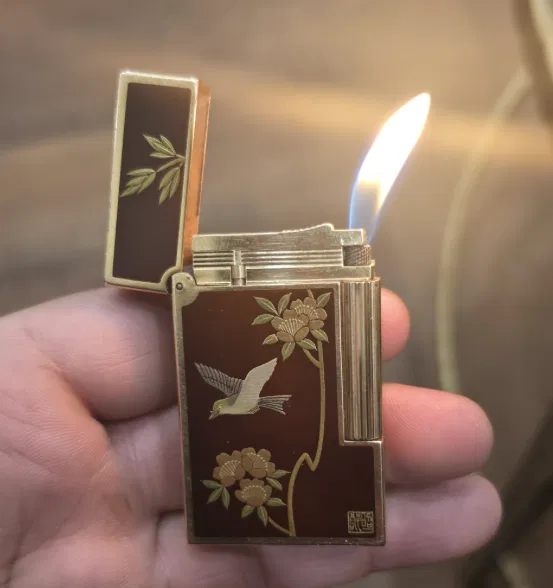
A surprising number of lighters sold as original fail right here. We have seen cranes and blossom on a Ligne 1, a model the maki-e programme never used, and a bird and peony design on brown lacquer, a combination that was never made. If the design, the model or the lacquer colour does not match a known original, it is aftermarket work, whatever the listing says, and the other checks hardly matter.
Check 2: the lacquer base under the maki-e
On an original piece the maki-e was worked into the lacquer panel itself. Aftermarket decoration is added on top of the factory lacquer that was already there. Two things show the difference: the surface and the edges.
Is the surface level?
Run a finger across the front of an original maki-e lighter and it feels like any other lacquered S.T. Dupont: completely smooth, with no edge to catch on. The gold and colour sit within the lacquer, and the surface has been polished level. Seen from the base or at a low angle, the face is perfectly flat.
A sticker is a layer on top. You can usually feel its outline, and from the side you can see it standing slightly proud of the lacquer. Under a loupe or in a sharp photo, printed areas often show a fine, regular dot pattern, especially in shaded parts such as fins or feathers. Real gold powder looks granular and uneven.
Where does the picture stop?
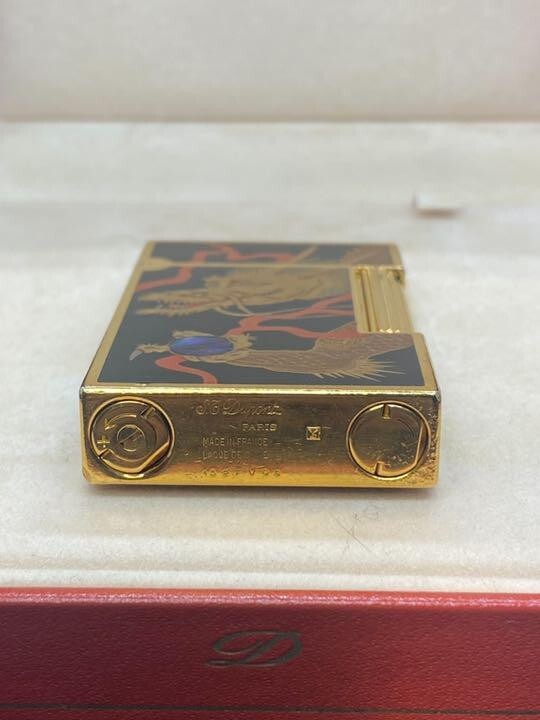
On an original piece the design ends exactly where the lacquer meets the gold trim, because it was worked into that lacquer panel and nowhere else. It never runs onto the gold, and the edges are clean.
Stickers rarely manage this. Look closely at the corners and along the trim, and especially at the hinge and the line between cap and body. On the aftermarket pieces we have handled, the image often stops just short of the trim and leaves a visible line. Elsewhere it may overlap the gold, or look slightly torn where it was cut to fit around the hinge.
Check 3: the signature and number
Every original vintage piece is signed by both S.T. Dupont and the Japanese artist and carries a serial number inscribed by the artist; the current collection is signed Zenni on the reverse. Keep in mind that the S.T. Dupont engraving and serial number on the base belong to the lighter, not to the decoration, so on an aftermarket piece they are original too.
The artist’s seal is usually a small red square set into the lacquer near a corner of the design. It is tempting to treat the seal as the answer. The makers of stickers have noticed this too, and some aftermarket pieces include a printed seal as part of the image. A seal counts only when it sits inside the lacquer like the rest of the design, and it proves nothing if the piece fails the first two checks.
Check 4: the papers and box
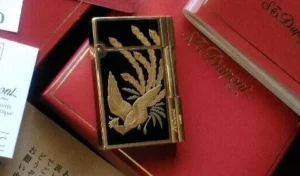
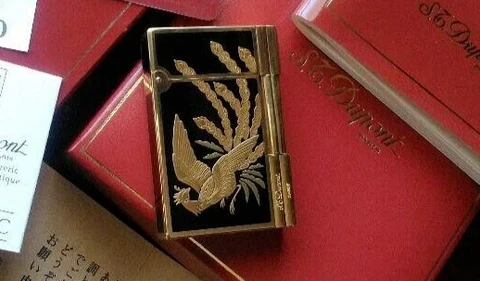
Original vintage pieces were commissioned through S.T. Dupont, and the set in the photo above shows them with the papers of the Japanese artist. When a seller asks the price of an original, ask to see the papers, and check that what they say matches the lighter in front of you. Papers alone are not proof, and a lighter without them can still be original, but a seller who claims an original should be able to tell you where its papers are.
The same goes for the box. On S.T. Dupont boxes and papers the reference code starts with the model code, 017 for the Line D and 019 for the Soubreny, followed by digits for the finish. A box with another model code belongs to another lighter.
Check 5: price and seller claims
Because the vintage pieces were commissioned and made by hand, original maki-e lighters are rare and priced accordingly. A listing well below what specialist dealers ask, for a lighter described as original S.T. Dupont maki-e, is the first warning sign. A private seller who cannot show the lighter from the side, from the base and with the cap open is the second. We would be especially careful with eBay listings shipped from Japan, where many of the stickered lighters we see seem to come from.
One collector contacted us after buying a “maki-e” Ligne 2 that looked wrong to him. The edges of the design were ragged, and the whole image sat clearly on top of the lacquer. In the end he lifted the sticker off both sides with his thumbnail, and underneath was a perfectly good lacquered S.T. Dupont in immaculate condition. He was lucky.
Do not try to lift a sticker yourself. It may be hiding exactly the damage you fear, and if the piece turns out to be original maki-e or fine commissioned work, you can harm the lacquer. Ask a specialist first.
If you own a commissioned aftermarket piece, enjoy it for what it is, and when you sell it, describe it as aftermarket work. Want a second opinion on a maki-e lighter? Send us photos of the front, the side, the base and the open lighter; the collectors of r/STDupont are also a good place to ask. Or browse the S.T. Dupont lighters we have now, each one checked, serviced and guaranteed authentic.
S.T. Dupont lighters available now
See all S.T. Dupont
Questions collectors ask
Is an aftermarket maki-e lighter still an original S.T. Dupont?
The lighter usually is. Most aftermarket maki-e we see sold as original is decoration added to an original S.T. Dupont, often a printed sticker over the lacquer, which is why the serial number and the engraving on the base will not help you here.
Is aftermarket maki-e bad?
Not in itself. Maki-e that a collector commissioned from a skilled artist can be fine craftsmanship. It is a different thing from original S.T. Dupont maki-e, and it should be sold as aftermarket work, not at the price of an original.
Did S.T. Dupont make maki-e Ligne 1 lighters?
Not as far as the known record shows. The vintage programme used the Line D and the Soubreny; the current collection is made on the Ligne 2 and Le Grand. A maki-e Ligne 1 is aftermarket work.
Does an artist's seal prove the maki-e is original?
No. Some stickers include a printed seal. A seal only means something when it sits within the lacquer and the design passes the other checks.
How can I tell a maki-e sticker from original maki-e?
Feel the surface and look from the side: original maki-e is level with the lacquer, a sticker stands slightly proud. Under a loupe a print shows a regular dot pattern, and it rarely ends cleanly at the gold trim.
Does S.T. Dupont still make maki-e lighters?
Yes. The current collection is on the Ligne 2 and Le Grand, decorated in Japan by Wajimaya Zenni and signed Zenni on the reverse. The vintage made to order programme on the Line D and Soubreny ended in 2003.
Sources and further reading
- Wikipedia: Maki-e meaning, Heian period, hira, taka and togidashi maki-e, raden
- Artbrown: the S.T. Dupont maki-e collection dealer overview with Line D and Soubreny maki-e pieces
- Kirby Allison: S.T. Dupont Line 2 maki-e Dragon current Ligne 2 maki-e by Wajimaya Zenni, Zenni signature on the reverse
- Cigar Coop: S.T. Dupont maki-e collection at PCA 2026 current Le Grand and Ligne 2 maki-e designs and list prices