S.T. Dupont Solid Gold Lighters: How to Tell 18k Gold from Plated
Most S.T. Dupont lighters are gold plated, but the 'or contrôlé 18 carats' collection was made in solid gold. How to recognise one: hallmarks, markings, weight and the models that were made.
By Max Meijster Updated 15 October 2026 8 min read
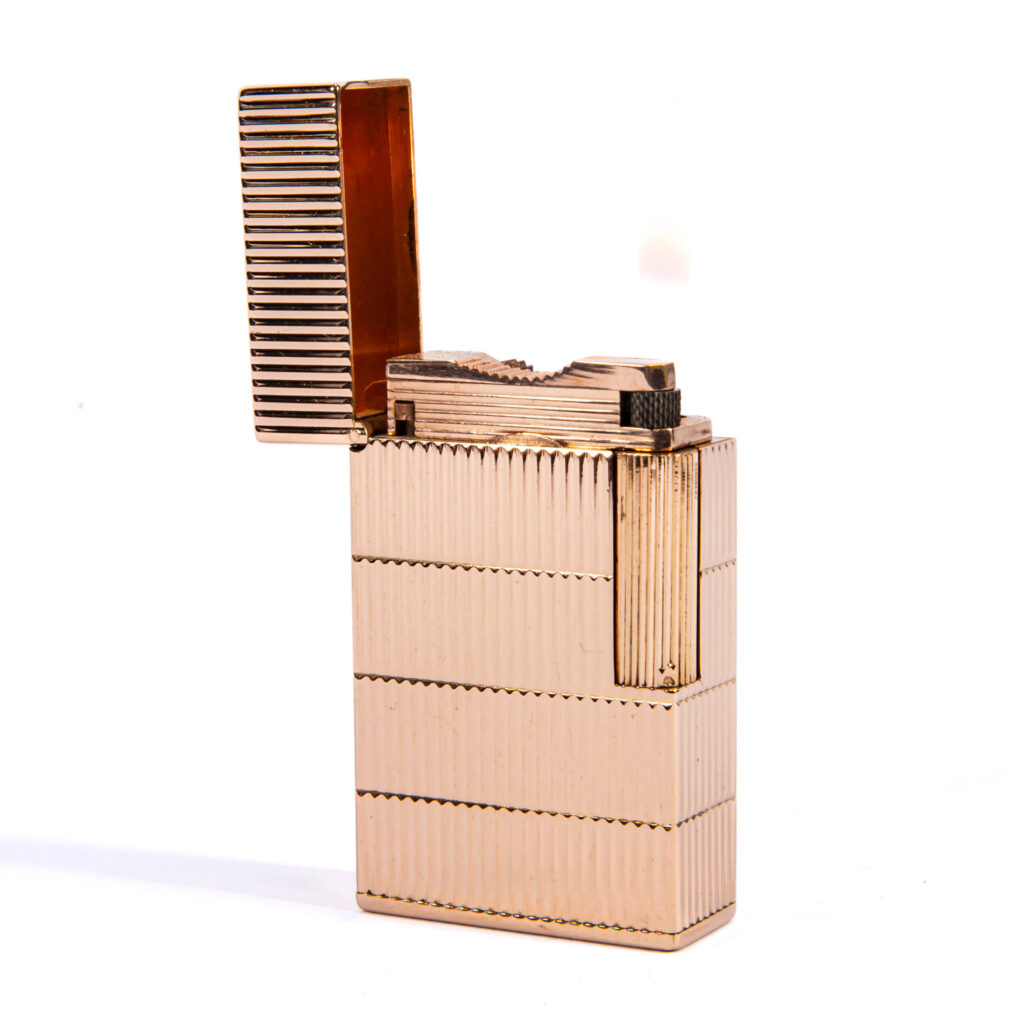
Most S.T. Dupont lighters are gold plated: a brass body with a layer of real gold, often 10 or 20 microns thick. A much smaller group is made of solid 18 carat gold. These lighters are hallmarked like fine jewellery, they are clearly heavier in the hand, and when new they cost about ten times as much as the plated versions.
This guide explains the solid gold collection S.T. Dupont called or contrôlé 18 carats, which models were made, how to read the hallmarks and the quick checks that tell solid gold from plated. Every solid gold S.T. Dupont we sell is weighed, checked for its hallmarks and serviced in our workshop.
Are S.T. Dupont lighters real gold?
Most are real gold on the outside only. The plated lighters carry a genuine gold layer over brass, and a good one wears very well, but at the edges and corners it can eventually wear through to the brass. A solid gold S.T. Dupont is gold all the way through its case. On a 1960s Ligne 1 we sold, even the refill cap and the flint wheel were 18 carat gold and individually stamped, with only the mechanism inside made of brass.
| Gold plated | Solid 18 carat gold | |
|---|---|---|
| Case | Brass with a layer of gold, often 10 or 20 microns | 18 carat gold (750 parts per thousand) |
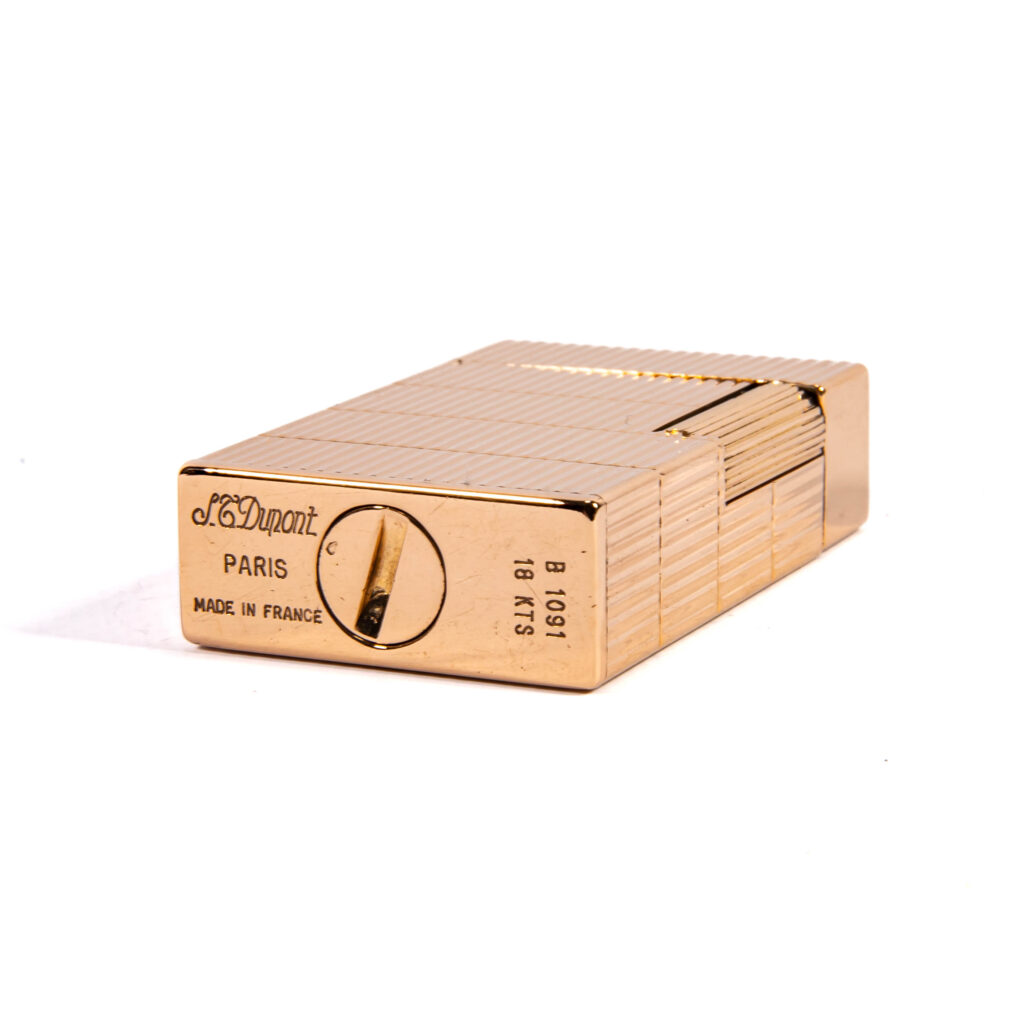
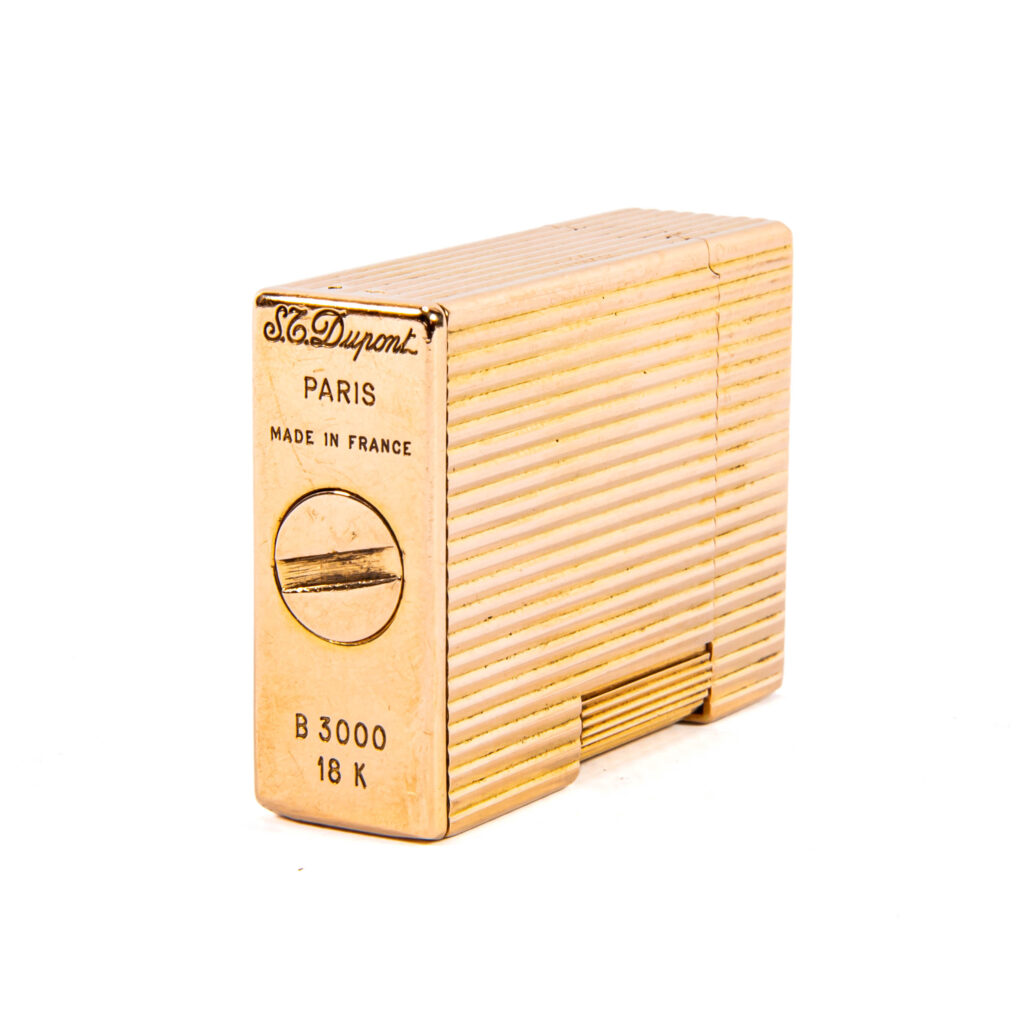
| Marks on the bottom | S.T. Dupont, Paris, Made in France and a serial | The same, plus 18 KTS or 18 K and a serial such as B 1091 |
| Hallmarks | None; only a small square stamp with the Dupont name, which is not a hallmark | French eagle’s head and a lozenge maker’s mark |
| Ligne 1 large, empty | about 95 g | about 115 to 135 g |
| Price when new (1964) | 117 to 295 francs | 2,050 to 2,300 francs |
The “or contrôlé 18 carats” collection
A two page S.T. Dupont advertisement from 1964 shows how the house presented its gold work. It signs off as Orfèvres à Paris, Paris goldsmiths, and shows sixteen lighters. The two at the top belong to the collection «or contrôlé 18 carats» (8 modèles): eight models in solid 18 carat gold, priced at 2,050 to 2,300 francs. The others are Chinese lacquer, gold plate of 10 or 20 microns and silver plate of 30 microns, at 117 to 295 francs.
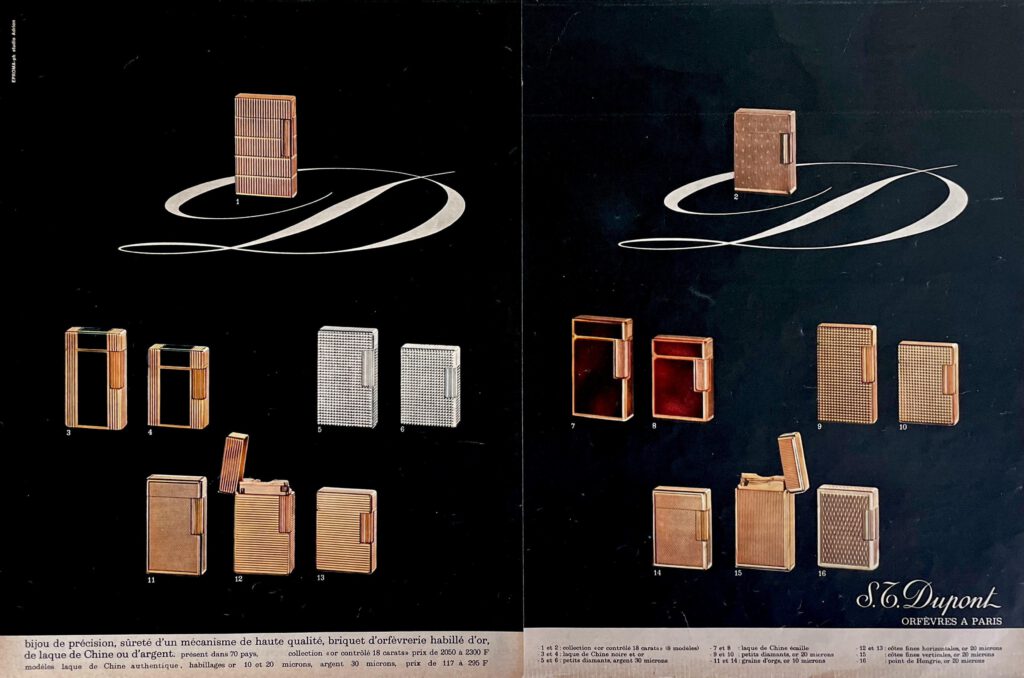
Or contrôlé is not a slogan. It means gold that has been tested by the French state assay office and struck with its hallmark. So solid gold S.T. Dupont lighters were never just one off curiosities: they were a catalogue collection with set patterns and set prices, next to the plated range.
The story of gold at S.T. Dupont is older still. The house’s first lighters of the early 1940s are linked to an order from the Maharaja of Patiala for lacquered evening cases, each holding a solid gold lighter. Read more in the history of the S.T. Dupont Ligne 1.
Who made the gold cases?
Calling itself Orfèvres à Paris was more than a slogan. A fully hallmarked gold lighter needs goldsmith tooling, a registered maker’s mark and a visit to the assay office, and the great Paris houses often had their finest gold work made by specialist workshops with their own maker’s marks.
Among collectors, the Paris workshop of Pierre G. Brun is sometimes named as the maker of early S.T. Dupont gold lighters, based on the format of the hallmarks and on collector accounts. This is a hypothesis, not a fact. Brun opened in 1936, worked for Cartier, Van Cleef & Arpels, Boucheron, Bulgari, Chaumet and Asprey, and was sold to Cartier in 2000, but S.T. Dupont is not on its known list of clients and we have seen no document that links the two. We hope to research this further.
Which S.T. Dupont models were made in solid gold?
The solid gold S.T. Dupont lighters we see are almost all Ligne 1 lighters from the 1960s and 1970s, in both versions (BS and BR) and both sizes. They work exactly like their plated brothers and take the same gas: red for the large Ligne 1, yellow for the small one. Not sure which version you have? See our guide to every S.T. Dupont model.
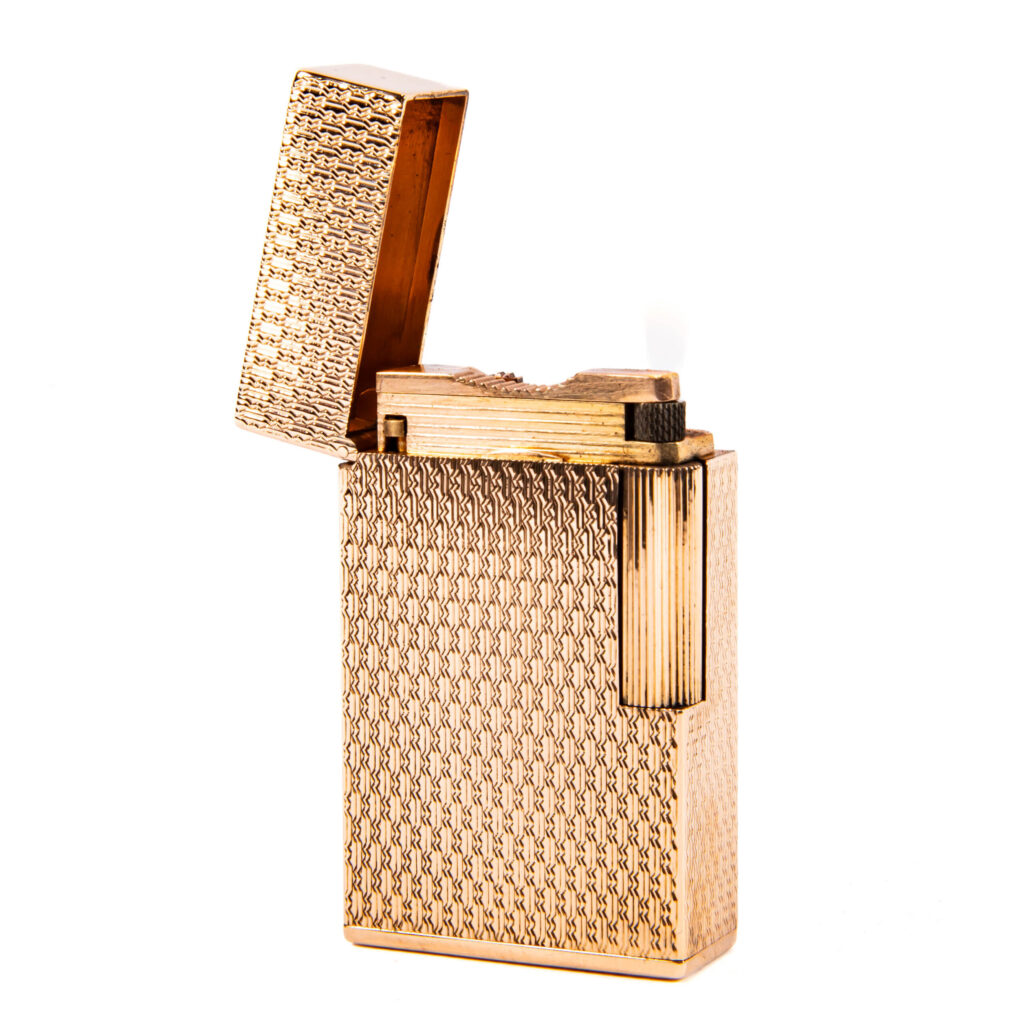
- Model
- Ligne 1 BS, large
- Gold
- Solid 18 carat
- Weight
- 115 g, empty
- Bottom
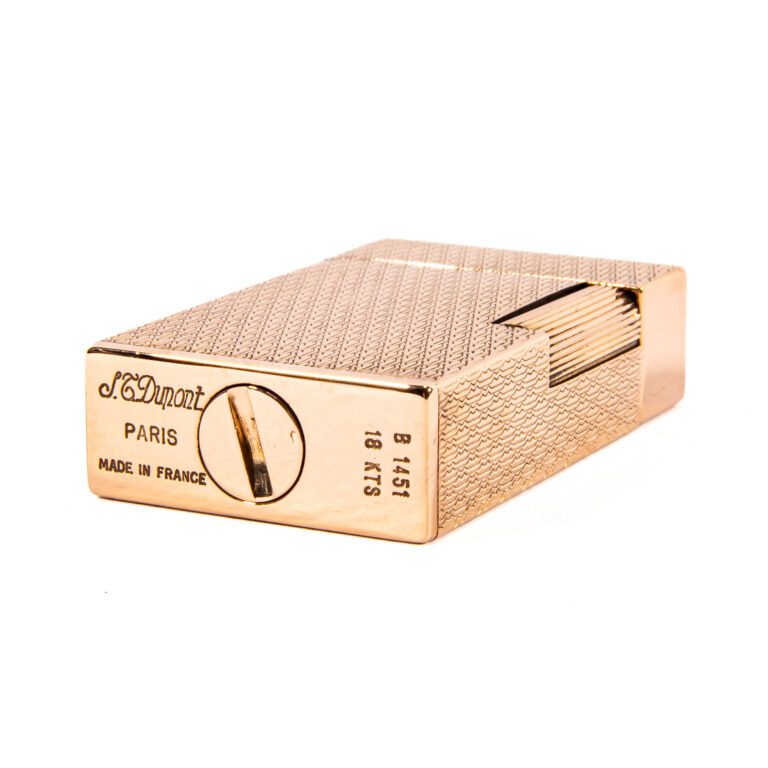
- B 1451, 18 KTS
- Gas
- red, flint
- Made
- 1968
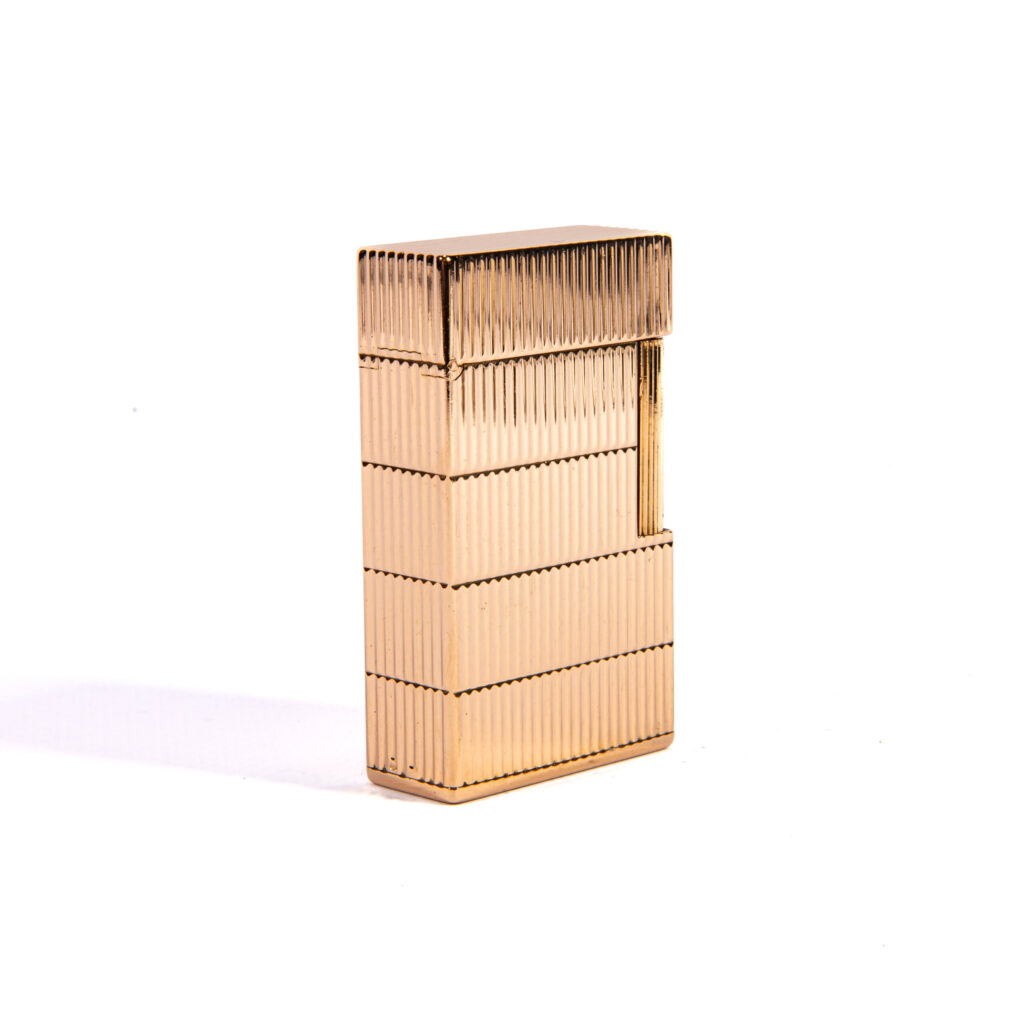
- Model
- Ligne 1 BS, large
- Gold
- Solid 18 carat, with gold refill cap and flint wheel
- Weight
- 135 g, empty
- Bottom
- B 1091, 18 KTS
- Gas
- red, flint
- Made
- 1960s
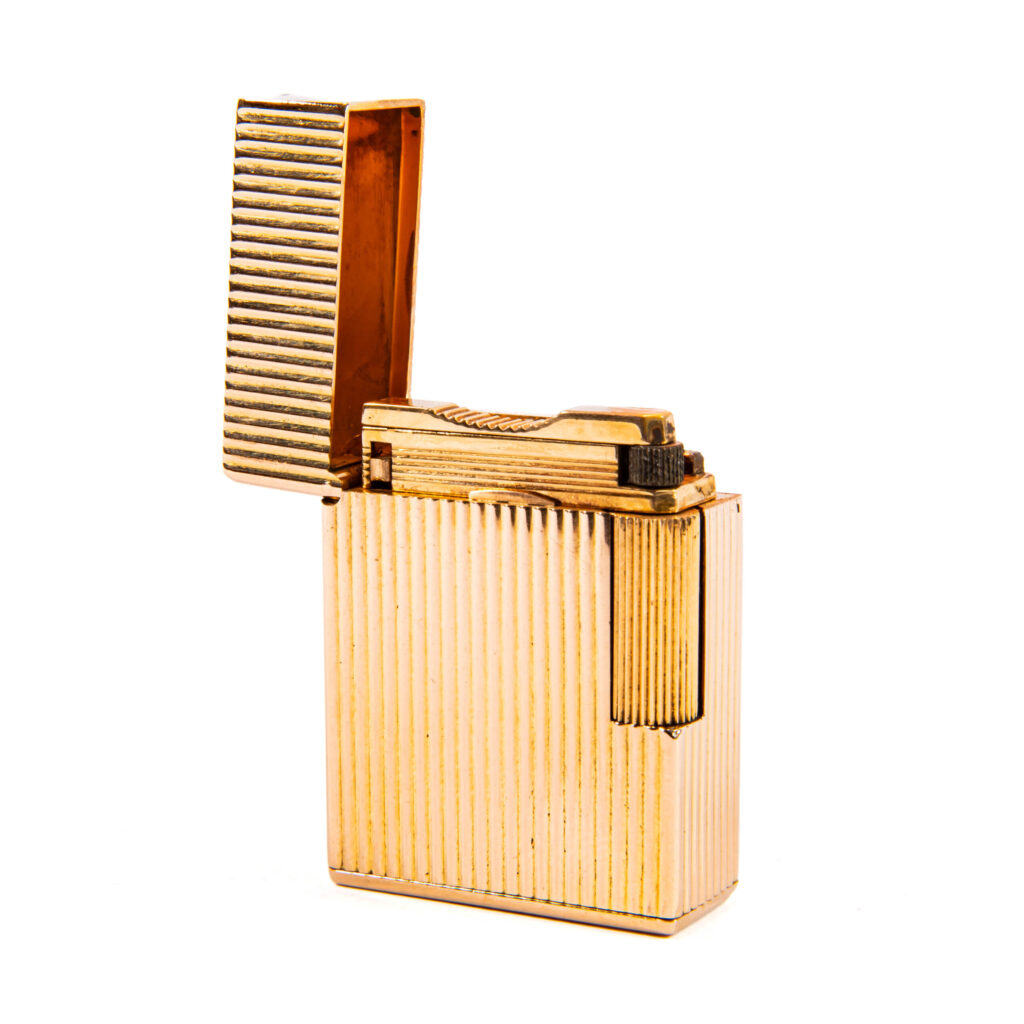
- Model
- Ligne 1 BR, small
- Gold
- Solid 18 carat
- Weight
- 100 g, empty
- Bottom
- B 3000, 18 K
- Gas
- yellow, flint
- Made
- 1970s
Solid gold pieces of other models exist too, but they are far rarer: the Ligne 2, the Line D (Ligne D), of which we know a solid gold example in a friend’s collection, and modern Prestige and Haute Création pieces made to order. The weights above are from lighters that passed through our workshop; a solid gold lighter that weighs about the same as a plated one deserves a very close look.
How to read the hallmarks
A solid gold S.T. Dupont carries a small group of marks, often struck in more than one place: on the body, inside the cap, on the base and sometimes on the refill cap and other small parts. A plated lighter has no reason to carry a gold hallmark on a hidden part, so a mark on the refill cap is a strong sign. The other way round, a lone 18K on an otherwise unmarked lighter is not enough: anyone can strike a number, only the assay office strikes the eagle’s head.
- The eagle’s head. The French state hallmark for 18 carat gold (750 parts per thousand). Introduced in Paris in 1838, it has been used across France since 1919. It is struck by the assay office, not by the maker. A vintage French gold lighter without it should be treated with great caution.
- The maker’s mark. A small lozenge (diamond shape) containing the maker’s initials and symbol. In France, the lozenge is reserved for makers of precious metal pieces.
- The fineness. 18 KTS, 18 K or 750, usually on the bottom next to the serial.
- The serial. On a solid gold Ligne 1 it is always the letter B and four digits, such as B 1091, B 1451 or B 3000, unlike the serials of plated lighters. The solid gold Line D we know has four digits and no letter.
- The signature. S.T. Dupont, Paris, Made in France. It proves the brand, not the metal: that is what the hallmarks are for.
The small square stamp is not a hallmark. On the bottom of every gold plated and silver plated S.T. Dupont you will find a tiny square stamp with the Dupont name in it. Many owners take it for a hallmark, but it is only the maker’s name: it says nothing about precious metal. In France the square shape is in fact used for plated pieces, while a maker of solid gold or silver strikes a lozenge. And a serial that happens to start with 18K, as on some later lighters, says nothing about the metal either.
Solid gold or plated: the quick checks
- Read the bottom. Look for 18 KTS, 18 K or 750 and, on a Ligne 1, a serial of B and four digits. A small square stamp with the Dupont name is not a gold mark: you find it on plated lighters.
- Find the eagle’s head and the lozenge. A loupe helps; the marks are small and can be worn.
- Weigh it. 18 carat gold is nearly twice as dense as brass, so even with a brass mechanism inside, a solid gold large Ligne 1 weighs about 115 to 135 g against about 95 g for a plated one.
- Check the wear. Plating can wear through to a yellow or pinkish brass at corners and edges. Solid gold shows no second metal underneath, only softer edges.
- Read the listing carefully. “18k gold plated”, “gold tone” or “20 microns” describe plating, not solid gold. A micron figure such as 20 µ is a plating thickness, so solid gold never carries one.
The engine turned patterns
The same advertisement names the patterns S.T. Dupont cut into its lighters. They were used on both plated and solid gold pieces:
- Graine d’orge (barleycorn): a fine, grainy engine turned texture.
- Côtes fines verticales and horizontales: fine ribs running up the body or across it.
- Point de Hongrie: a chevron or herringbone pattern.
- Petits diamants: small raised diamond points, often called diamond head.
Plain polished gold exists as well, and many solid gold pieces carry a personal engraving: initials, a date or a monogram. Crisp, sharp engine turning is a good sign; soft, rounded lines often mean heavy polishing.
What to check before you buy
- Marks: present, complete and consistent: eagle’s head, maker’s mark, 18 KTS or 750 and the serial.
- Weight: in line with the model. Ask the seller to weigh it if the listing does not say.
- Condition: crisp engine turning, no polished out engraving, a cap that closes firmly.
- Completeness: the original box and papers add value, as does a known history.
- Factory or later jacket: independent workshops, many of them Italian, made silver and sometimes gold jackets for S.T. Dupont lighters. They are real precious metal but not factory work: the marks are often in one place only or from another country, and there is usually no S.T. Dupont name or serial on the jacket. Not a fake, but priced for its gold rather than as a factory piece.
- Authenticity: a fake can be gold too. Run the general checks from our guide on how to spot a fake S.T. Dupont.
Prices depend on condition, pattern, completeness and history; the rarest pieces in full sets can reach five figures in euros. A solid gold lighter also has a floor: it is never worth less than the gold it contains. Looking for one? See our vintage solid gold lighters, each one weighed, checked for its hallmarks and serviced, or the wider choice of vintage Ligne 1 lighters. For the rarest gold lighter in watchmaking, read about the Patek Philippe Golden Ellipse lighter.
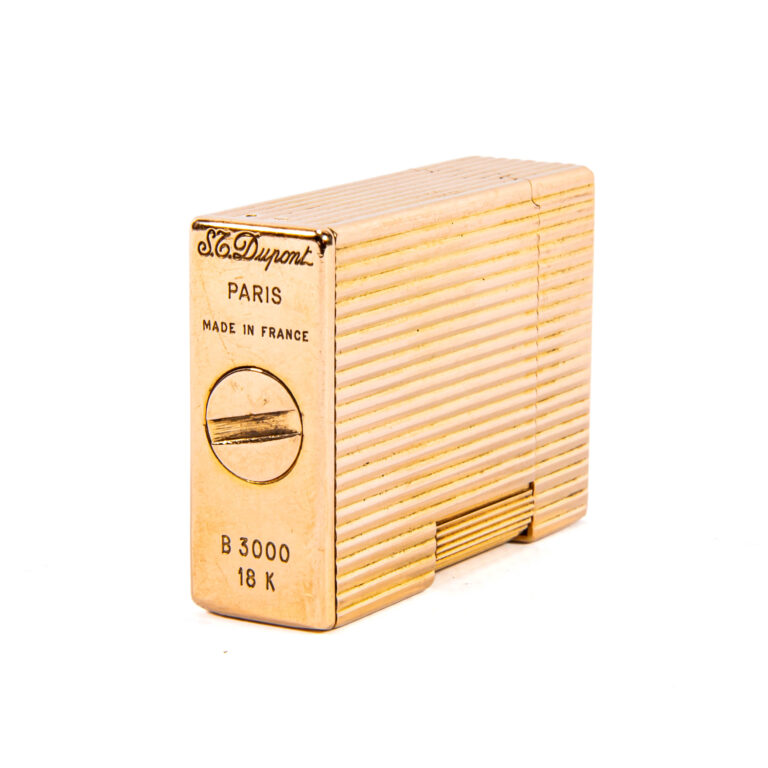
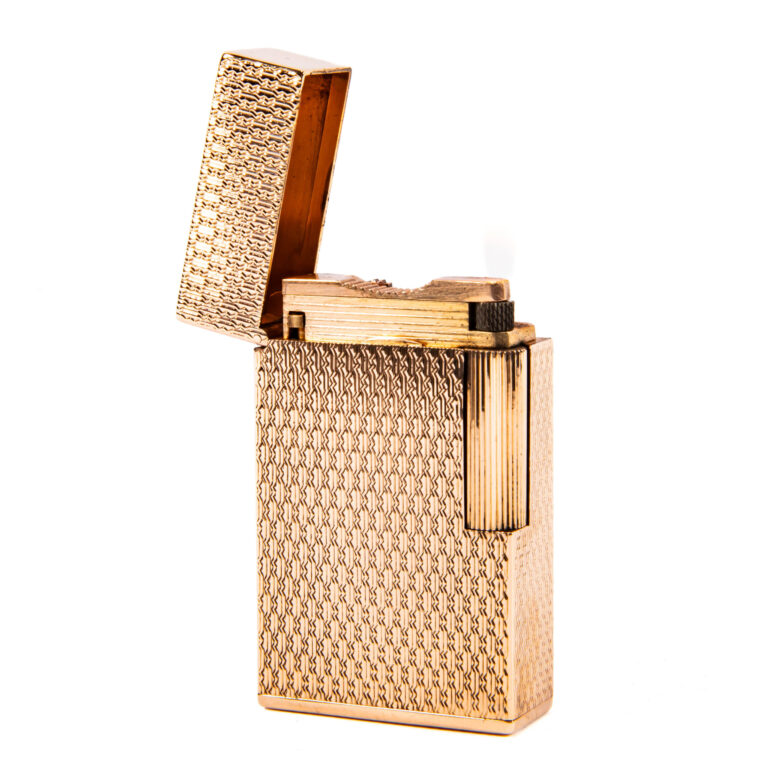
Vintage solid gold lighters available now
See all solid gold lighters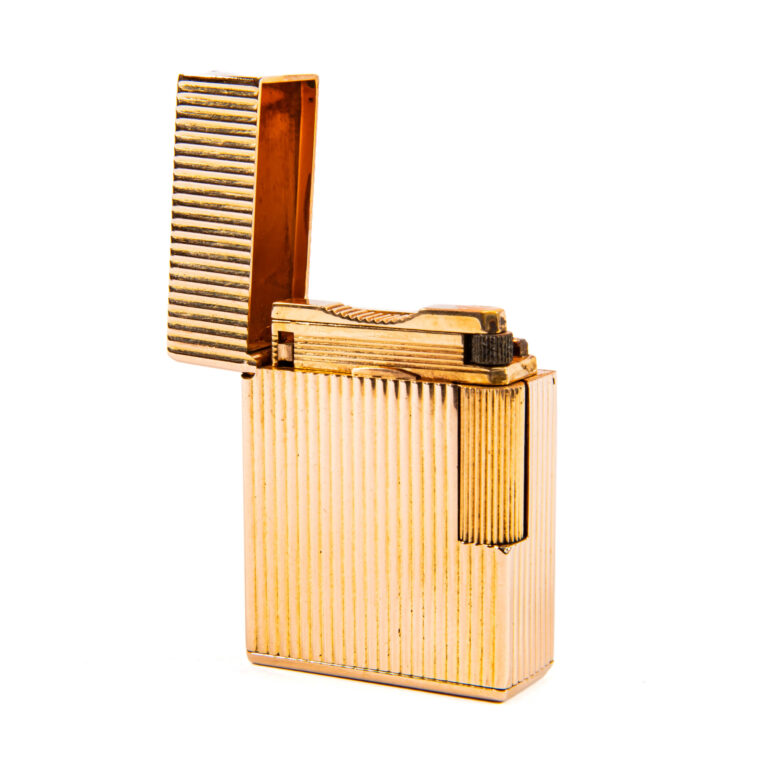
Questions collectors ask
Are S.T. Dupont lighters real gold?
Most are gold plated: real gold over a brass body. A smaller number were made in solid 18 carat gold and are hallmarked with the French eagle's head and marked 18 KTS, 18 K or 750.
How can I tell if my S.T. Dupont is solid gold?
Look for 18 KTS, 18 K or 750 on the bottom, the eagle's head and a lozenge maker's mark, and weigh it: a solid gold large Ligne 1 weighs about 115 to 135 g empty, a plated one about 95 g.
What does 'or contrôlé 18 carats' mean?
It means 18 carat gold that has been tested by the French state assay office and carries its hallmark. S.T. Dupont used the phrase for its solid gold lighter collection.
Is the small square stamp on the bottom of my S.T. Dupont a hallmark?
No. Gold plated and silver plated S.T. Dupont lighters carry a small square stamp with the Dupont name on the bottom; it is the maker's name, not a hallmark, and it says nothing about precious metal. Solid gold has the eagle's head and a lozenge maker's mark.
How much does a solid gold S.T. Dupont lighter weigh?
The solid gold Ligne 1 lighters we have handled weighed 115 and 135 g (large) and 100 g (small), empty. Plated versions weigh about 95 g and 80 g.
Where can I buy a solid gold S.T. Dupont lighter?
From a specialist who checks the hallmarks and the weight and guarantees authenticity. See our vintage solid gold lighters.
Sources and further reading
- Comme un camion: lexicon of French hallmarks eagle's head for 18 carat gold, lozenge for makers, square for plated pieces
- Vintage jewellery hallmark guide: France eagle's head from 1838 in Paris, horse's head in the provinces until 1919
- Achat Or et Argent: hallmarks for gold eagle's head for 750 gold; square means plated
- Avenue of Aesthetic: S.T. Dupont solid gold lighters, a collector's guide to 18k, hallmarks and value collector guide (Oct 2026): repeated hallmarks, micron marks mean plating, later gold jackets, a solid gold Ligne D with serial 0144
- Fellows: Pierre Brun, designer profile Brun workshop opened in Paris in 1936, its clients, sold to Cartier in 2000