Vintage Cartier Lighter Models: The Complete Guide (1968 to Today)
Les Must, Santos, Trinity, Pentagon, the minis and the Desk: every vintage Cartier lighter model side by side, and how to tell which one you have.
By Max Meijster Updated 15 October 2026 12 min read
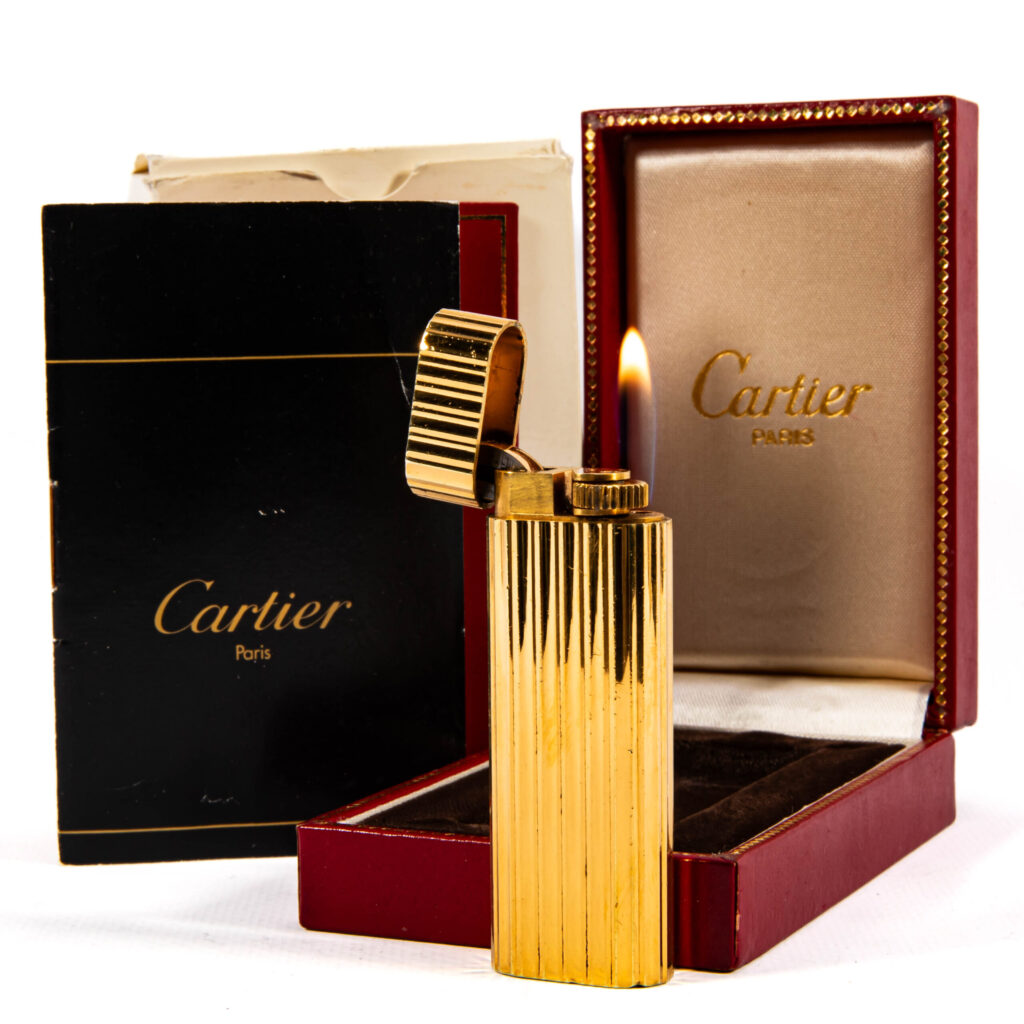
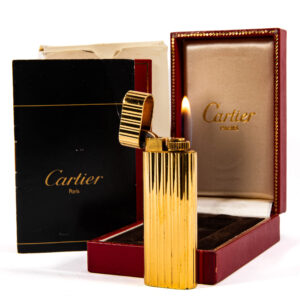
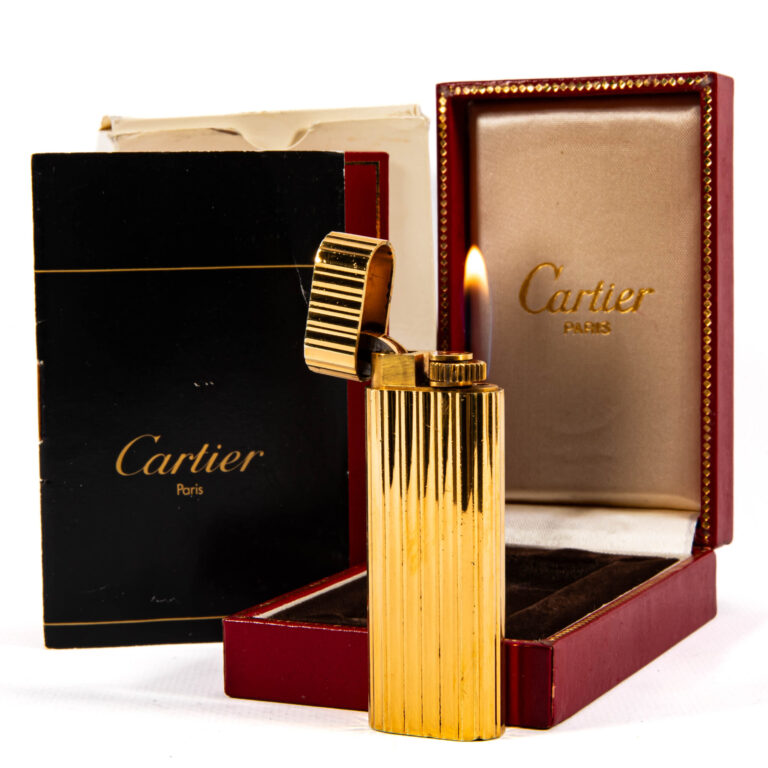
Cartier made its first gas lighter in 1968: a slim, oval lighter in gold plate, often with fine vertical flutes. It sold so well that five years later it became the first piece of Les Must de Cartier. Over the next decades the same compact lighter appeared as the Santos, the Trinity and the Pentagon, in mini and desk sizes, and in everything from gold plate to Chinese lacquer and solid 18 carat gold.
This guide lists every vintage Cartier lighter model we know, shows how to tell them apart and what the base of a Cartier tells you, with a card per model. Every photo is a piece that passed through our workshop.
Every vintage Cartier lighter at a glance
Heights are our own measurements; all full size models are about 25 mm wide and 12 mm thick (the Oval is wider). The years are the periods we see on the pieces we handle, not official production dates.
| Model | Made | Shape | Height | Fuel | Typical finishes |
|---|---|---|---|---|---|
| Les Must | From 1968 | Slim oval case | 70 mm | Butane | Gold and silver plate (godron, barley and other patterns), Chinese lacquer, solid gold, sterling silver, cabochons |
| Les Must Mini | 1980s and 1990s | Oval, shorter | about 59 mm | Butane | Gold plate, lacquer (malachite, marble) |
| Santos | From the late 1970s | Oval, two tone with screw motifs | 70 mm | Butane | Gold and silver plate, two tone |
| Trinity | 1970s to 1990s | Oval, cap in three bands | 70 mm | Butane | Gold and silver plate, lacquer, solid gold |
| Trinity Mini | 1990s | Oval, shorter, three bands | about 57 mm | Butane | Lacquer, silver plate |
| Pentagon | 1970s and 1980s | Five flat facets | 70 mm | Butane | Gold and silver plate (brushed, guilloché), lacquer |
| Pentagon Mini | 1970s and 1980s | Five facets, short | about 50 mm | Butane | Silver plate, lacquer |
| Oval | Later, Swiss made | Wider body, sideways flame | 60 mm | Butane | Gold plate with lacquer |
| Les Must Desk | 1990s | Tall oval, for the desk | about 124 mm | Butane | Gold and silver plate |
| Petrol lighters | Before 1968 | Various, some with a watch | varies | Lighter fluid | Solid silver, solid gold |
From the first lighter to Les Must de Cartier
The Cartier lighter began with a licence. In 1968 Cartier allowed Robert Hocq, head of the lighter maker Silver Match, to make a lighter under the Cartier name. It was oval, gold plated rather than solid gold to keep the price within reach, and it came in Cartier packaging. Sales went well beyond what anyone expected.
In 1969 Hocq brought in the young Alain Dominique Perrin to run Briquets Cartier, the lighter business. Perrin placed the lighters with fine tobacconists and jewellers, and in 1972 Hocq’s group bought Cartier Paris itself. In 1973 Hocq and Perrin created Les Must de Cartier, a line of more accessible Cartier objects that started with the lighter and grew into pens, leather goods and watches. That is why so many vintage Cartier lighters, boxes and papers carry the words “must de Cartier”.
Perrin also moved away from licensing: Cartier took the making of its lighters in house, and its factory in Fribourg, Switzerland, made lighters, pens and clocks before it turned to watch parts. Cartier still sells lighters today, such as a square Santos de Cartier lighter, but collectors mostly look for the models below.
The models share one mechanism under different cases: a hinged cap, a flint wheel and a refill valve in the base, all running on ordinary butane. So the care and refill steps in our Cartier lighter maintenance guide apply to all of them.
The first Cartier lighters (late 1960s)
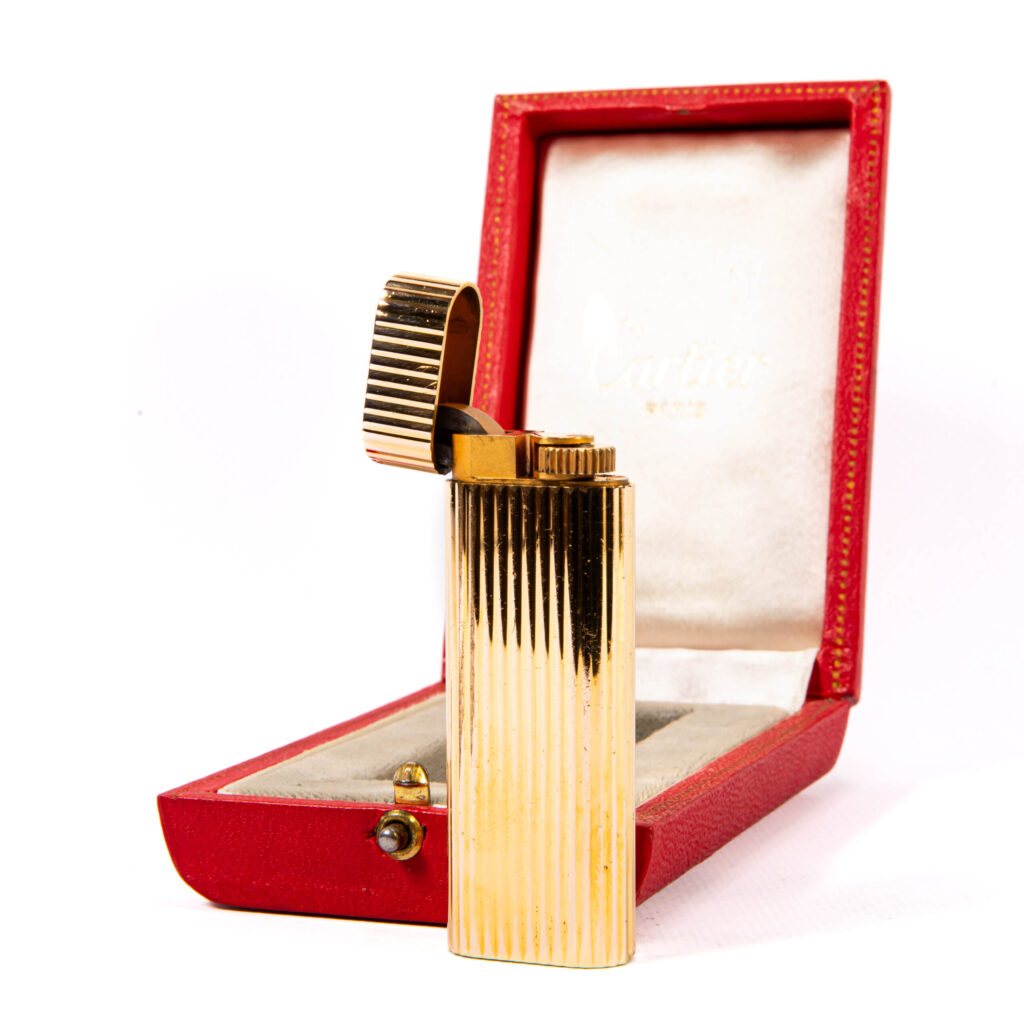
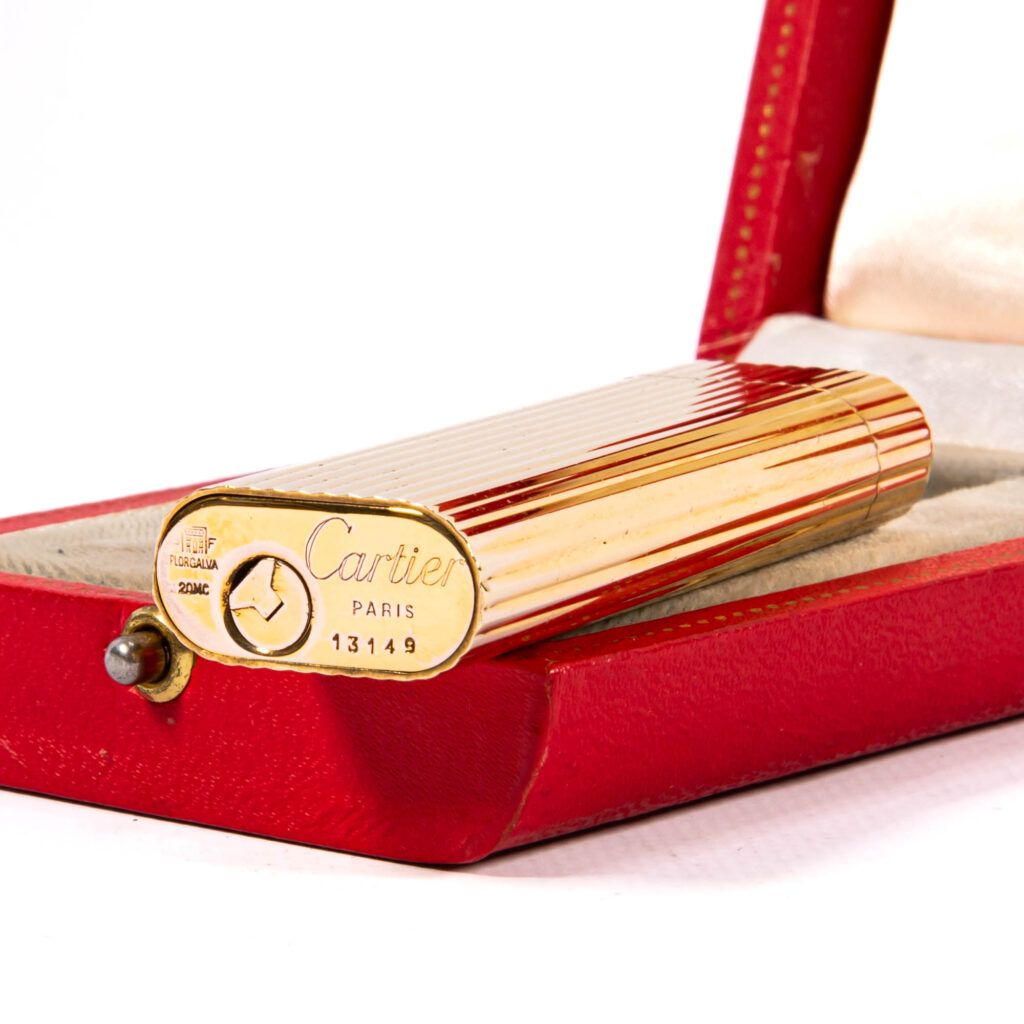
The very first Cartier lighters, from the late 1960s, differ from every later one in a way you only see underneath. Their gas tank had no filling valve: it was not refillable, but a part that was meant to be replaced. So the base is a solid plate with just one screw in it.
That screw does three jobs: it holds the lighter together, it pushes the flint up against the wheel, and it sets the flame. There is no D shaped cover beside it, so to reach the tank you take out the screw and remove the whole bottom plate, every single time.
This first version was made only for a short time. Cartier then changed to a refillable gas tank with a filling valve, and added the small hinged D shaped cover on the base that you lift to reach it: the base you find on almost every Les Must. The early lighters also have very short serial numbers. They are rare: we have had two, one in solid gold and one gold plated.
How to identify a Cartier lighter
- Look at the shape. A rounded oval case is a Les Must, Santos or Trinity. Five flat facets make a Pentagon. A wider body with a flame that comes out sideways is the later Oval.
- Look at the decoration. Screws on the cap and body mean a Santos. A cap wrapped in three bands of differently coloured gold means a Trinity. Plain, patterned, fluted or lacquered without either is a Les Must.
- Measure the height. About 70 mm is a full size lighter. About 57 to 59 mm is a Les Must Mini or Trinity Mini, about 50 mm a Pentagon Mini, and about 124 mm a Les Must Desk. About 60 mm with a wider, thicker body is the Oval.
- Read the base. A vintage Les Must family lighter is marked “Cartier Paris” with the metal and a serial number; more on that below.
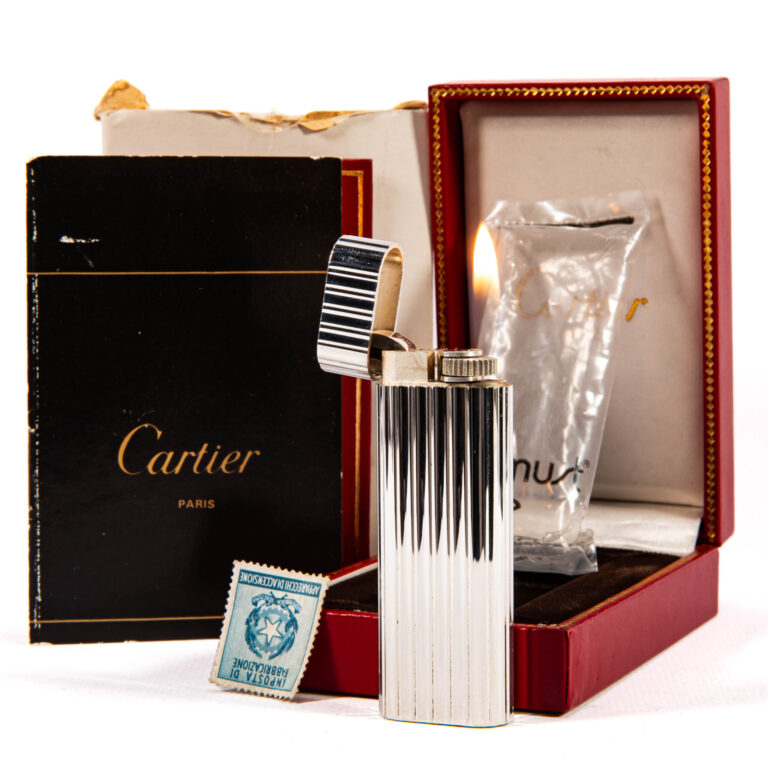
- Check the box and papers. Most came in a red Cartier box with a gold border, with an international guarantee certificate (“Certificat de garantie internationale”).
What the base tells you: markings and serial numbers
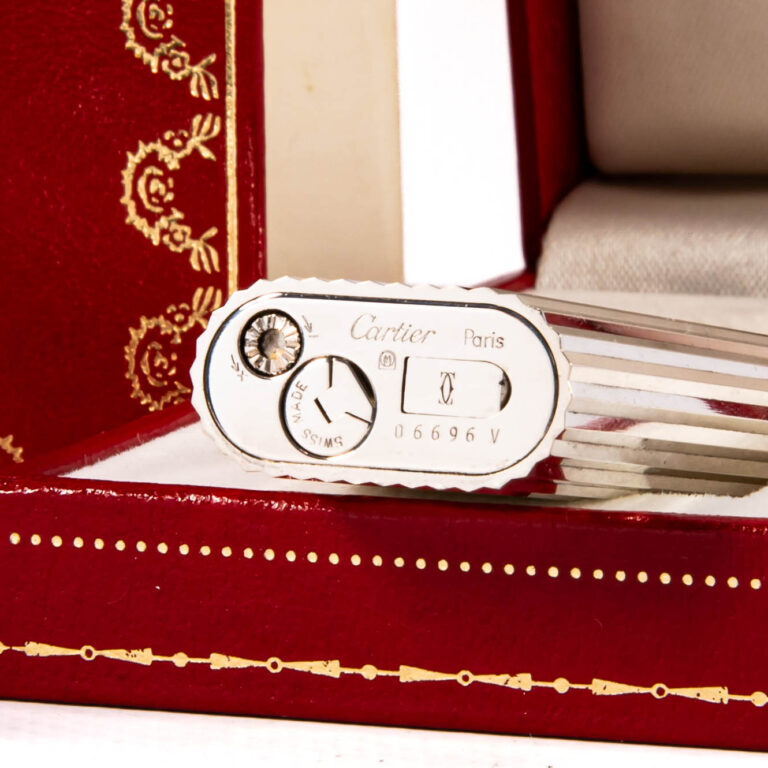
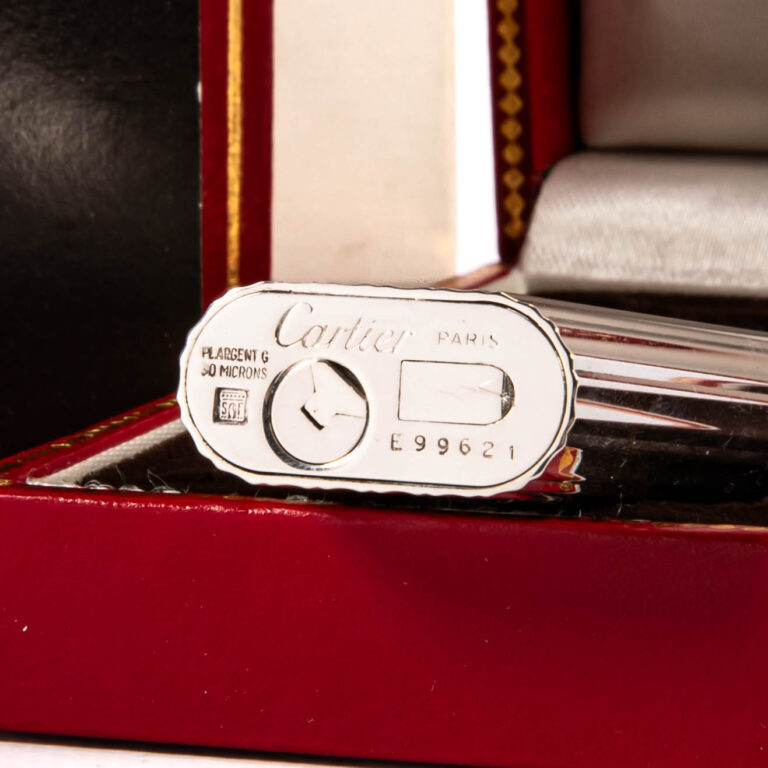
Turn a vintage Cartier over and you will normally find “Cartier” in script with “Paris”, the refill valve under a small hinged D shaped cover, the round screw that holds the flint and sets the flame, a mark for the metal and a serial number. The very first lighters have only the screw: see the first Cartier lighters. On gold plated pieces the metal mark reads “Plaqué or G”; solid gold and sterling silver pieces carry the hallmarks for the precious metal instead. Later models such as the Oval are marked “Swiss made”.
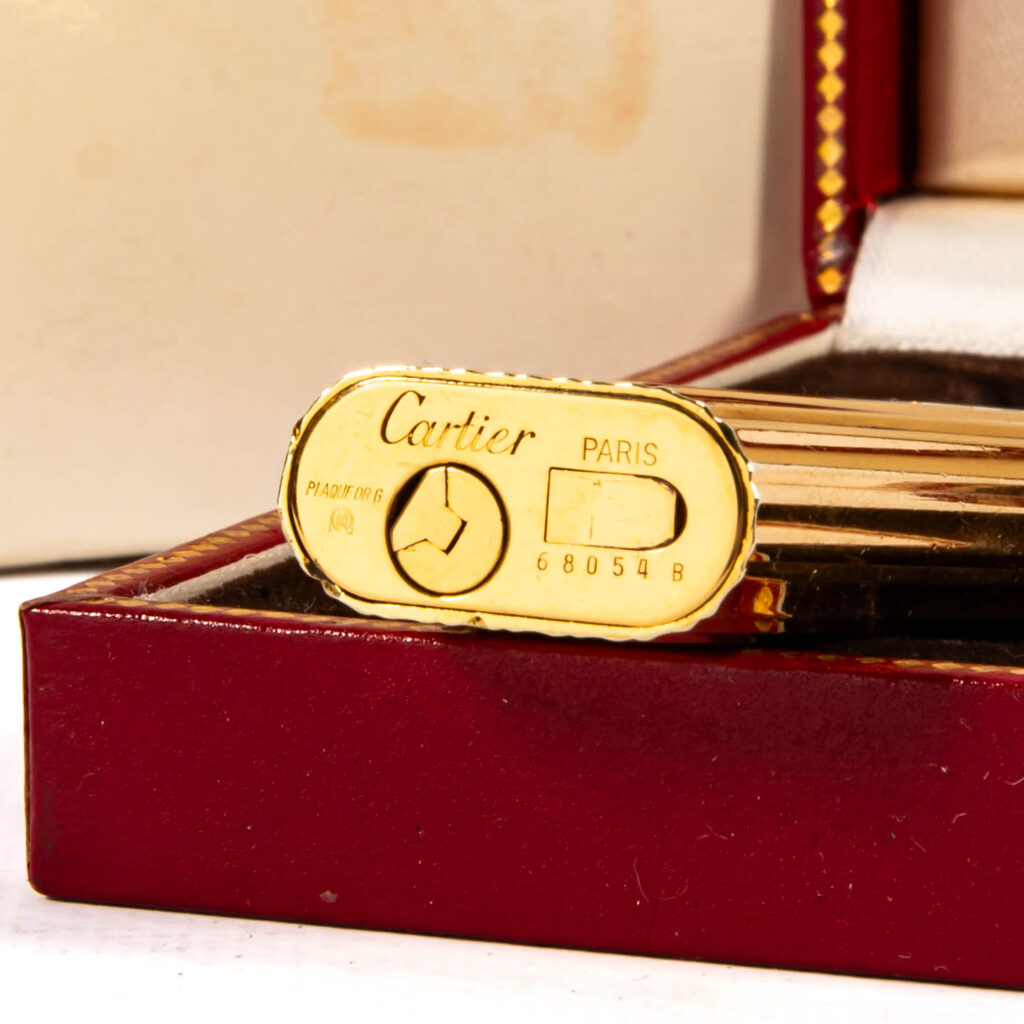
As far as we know, Cartier never published a key to its lighter serial numbers, so a serial alone cannot date a lighter. What we do see on the pieces we handle:
- Lighters we date to the 1960s have a short, plain number of five digits, such as 13149 on one of the first lighters.
- From the 1970s many have five digits followed by a letter, such as 68054 B.
- Later pieces mix letters and digits, with the letter first or in the middle.
We are working on this. We collect the serial numbers of Cartier lighters that still have their guarantee papers filled in, to date the serials more precisely over time. Do you have a Cartier with its papers? Send us the serial number and a photo of the papers: every one helps.
Engraving that is sharp and clean, a solid feel and a smooth, even hinge all count for more than any number. If you doubt a lighter, send us photos of the base and the open cap and we will tell you what we see.
Les Must (from 1968)
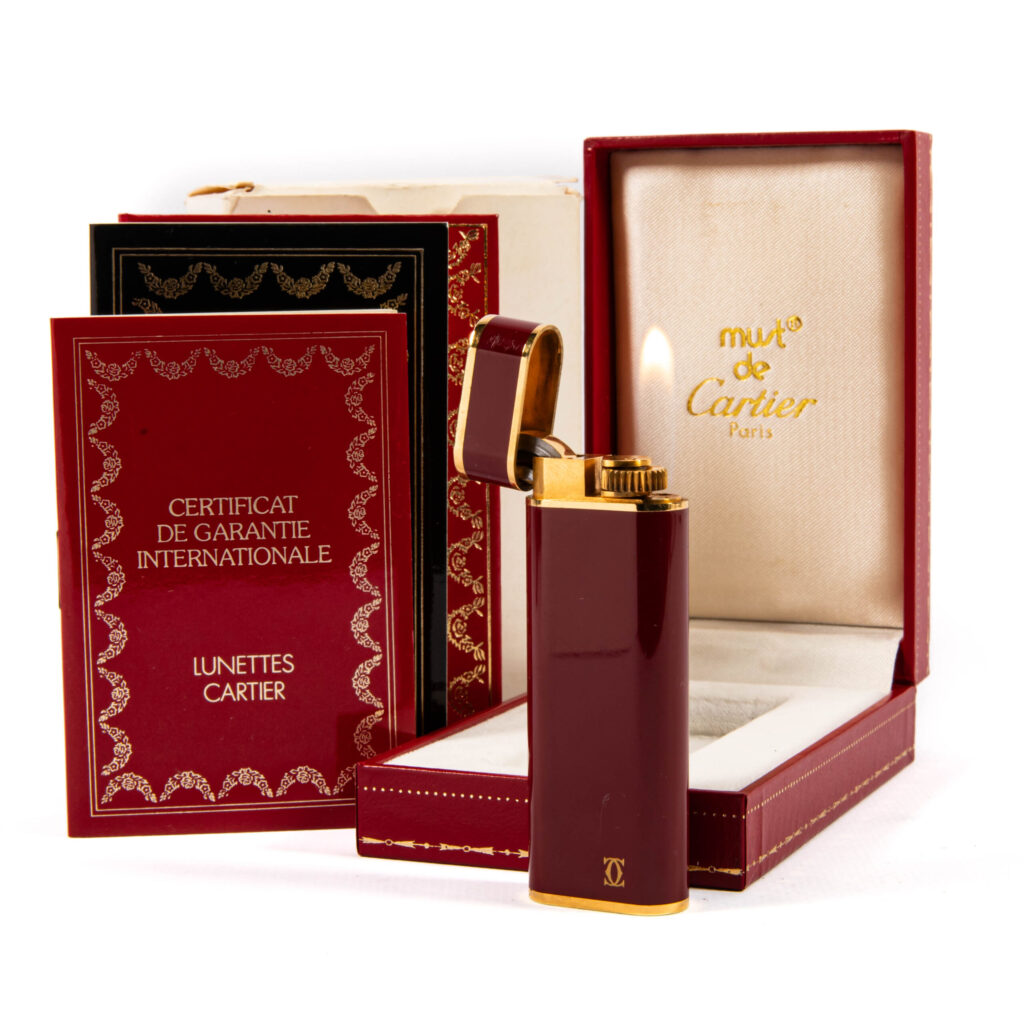
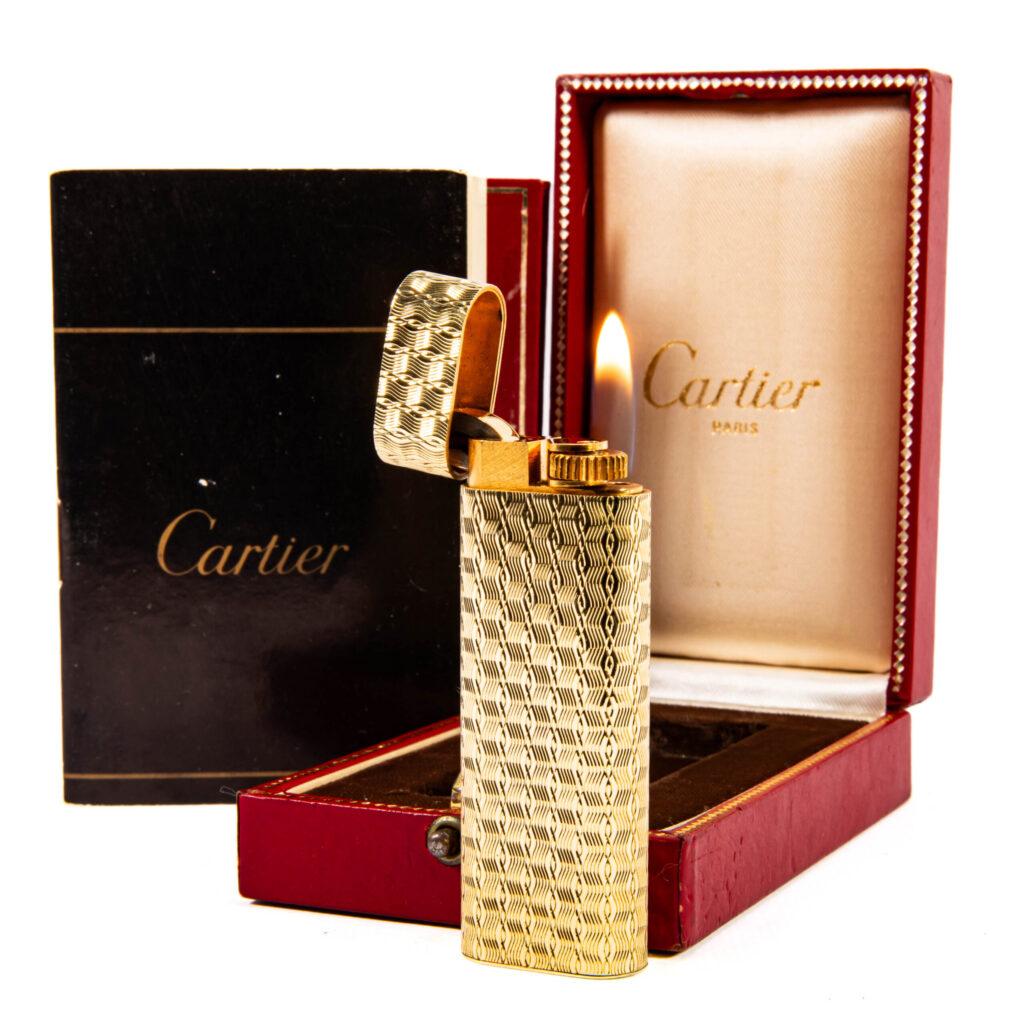
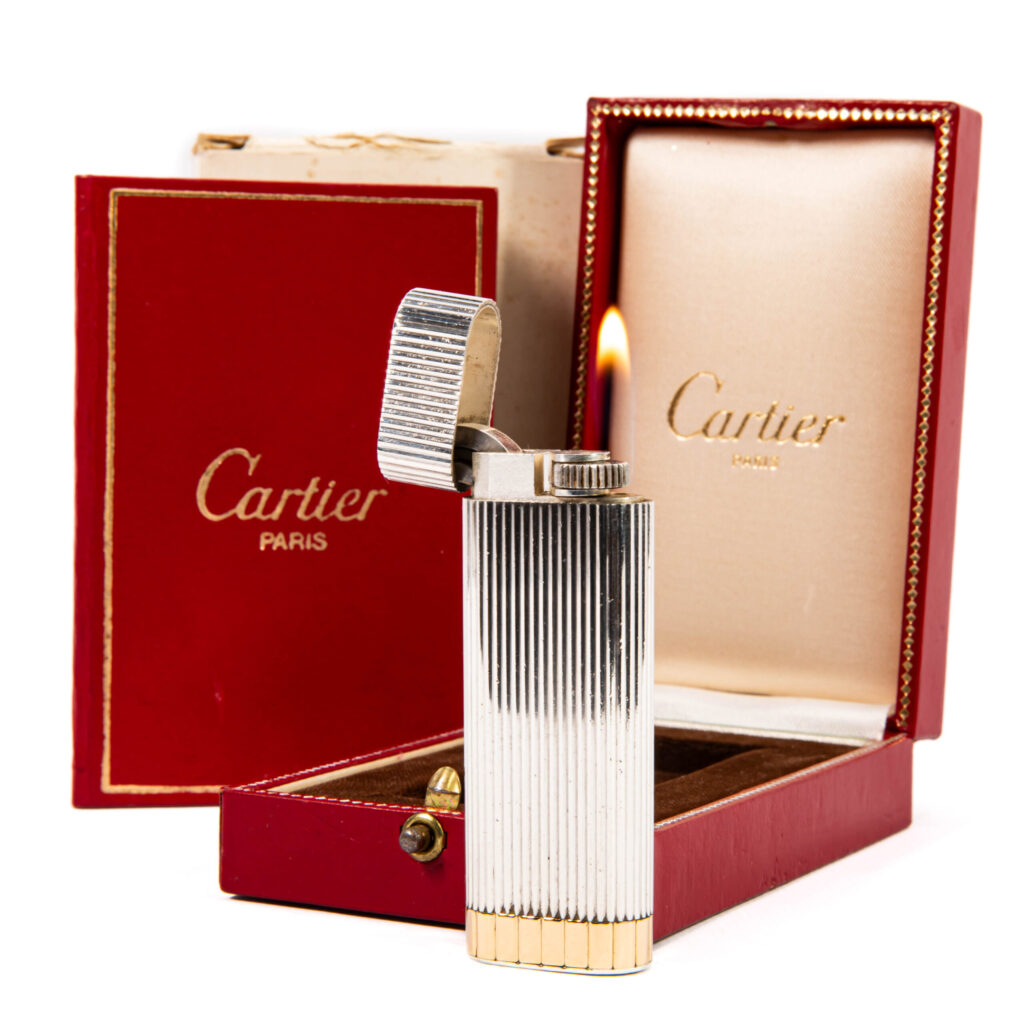
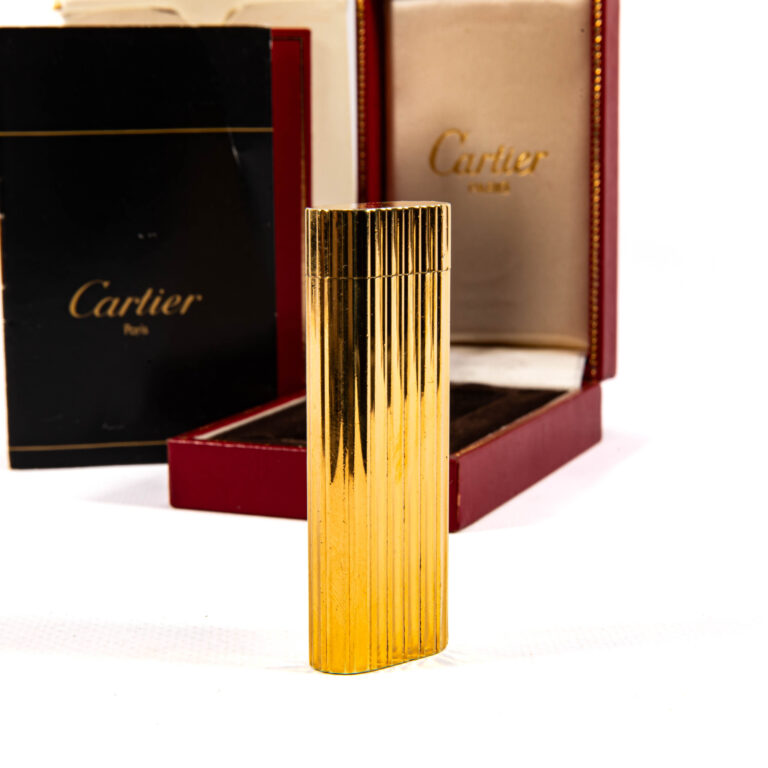
The Les Must is the original Cartier lighter and still the one most people mean when they search for a vintage Cartier. Its slim oval case carries a hinged cap and a flint wheel beside the burner. The best known finish is the godron: fine vertical flutes in gold plate. Beside it came barley and other engine turned patterns, plain polished plate, Chinese lacquer in bordeaux, black, blue, green and tortoiseshell, and versions set with a sapphire or ruby cabochon.
- Fuel
- Butane and flint
- Size
- 70 × 25 × 12 mm
- Weight
- About 73 g in plate; 84 to 91 g in solid 18 carat gold
- Made
- From 1968; in Les Must de Cartier from 1973
- Known for
- The fluted godron, lacquer colours, solid gold and silver versions
- In our shop
- Les Must lighters
At the top end, Cartier made the Les Must in solid 18 carat gold, some set with diamonds, and in sterling silver, sometimes with a band of gold. Cartier made its gold lighters either gold plated or in solid gold; it never made jackets or sleeves. When you find a Cartier inside a gold or silver jacket, the lighter is original, but the jacket is custom, aftermarket work. Browse our vintage solid gold lighters and solid silver lighters for the precious metal pieces we have now.
Les Must Mini
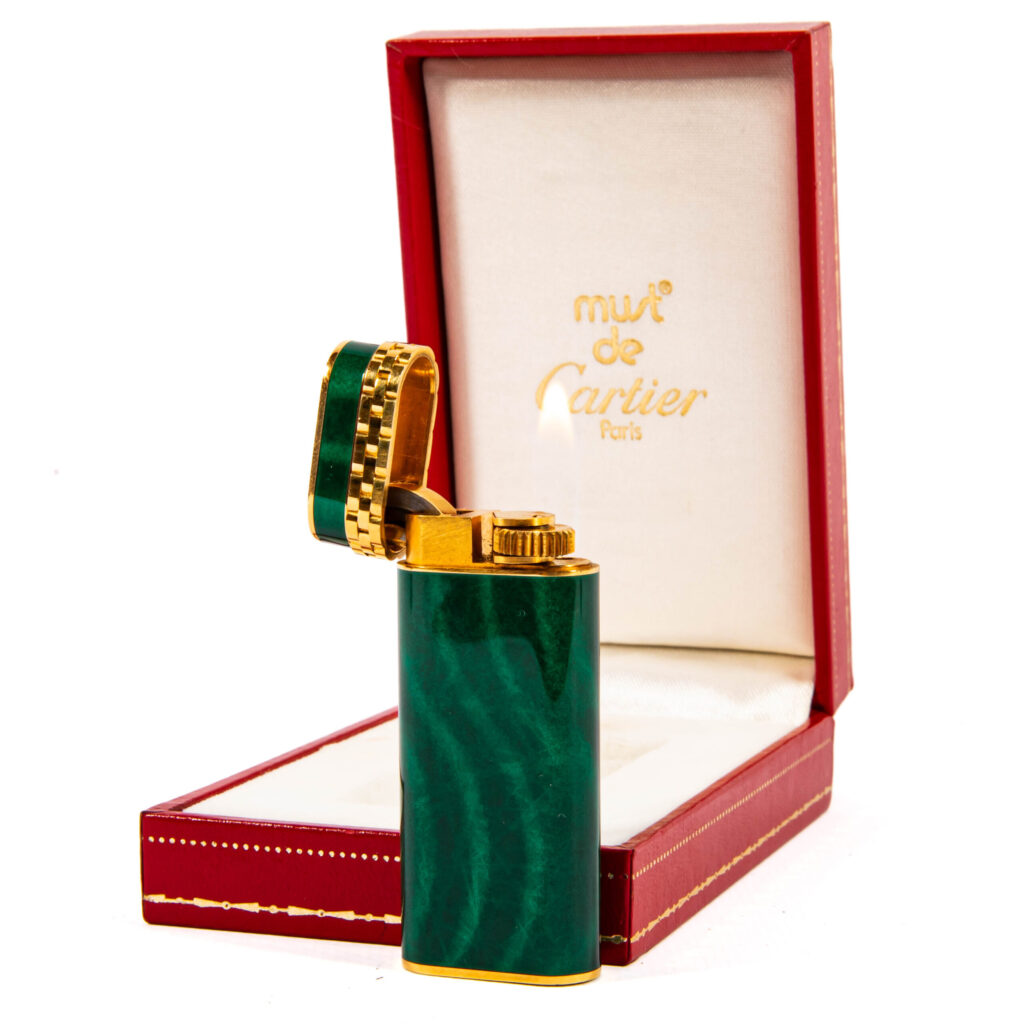
The Les Must Mini is the same lighter, shortened by about a centimetre. It holds less gas, so it needs filling more often, but it sits easily in a small bag or an evening jacket. We mostly see it in gold plate and in lacquer, including malachite and marble effects.
- Fuel
- Butane and flint
- Size
- About 59 × 25 × 12 mm
- Weight
- About 71 g in gold plate, 66 g in lacquer
- Made
- 1980s and 1990s on the pieces we see
- Known for
- A shorter Les Must, often in bright lacquer
- In our shop
- Les Must Mini lighters
Santos
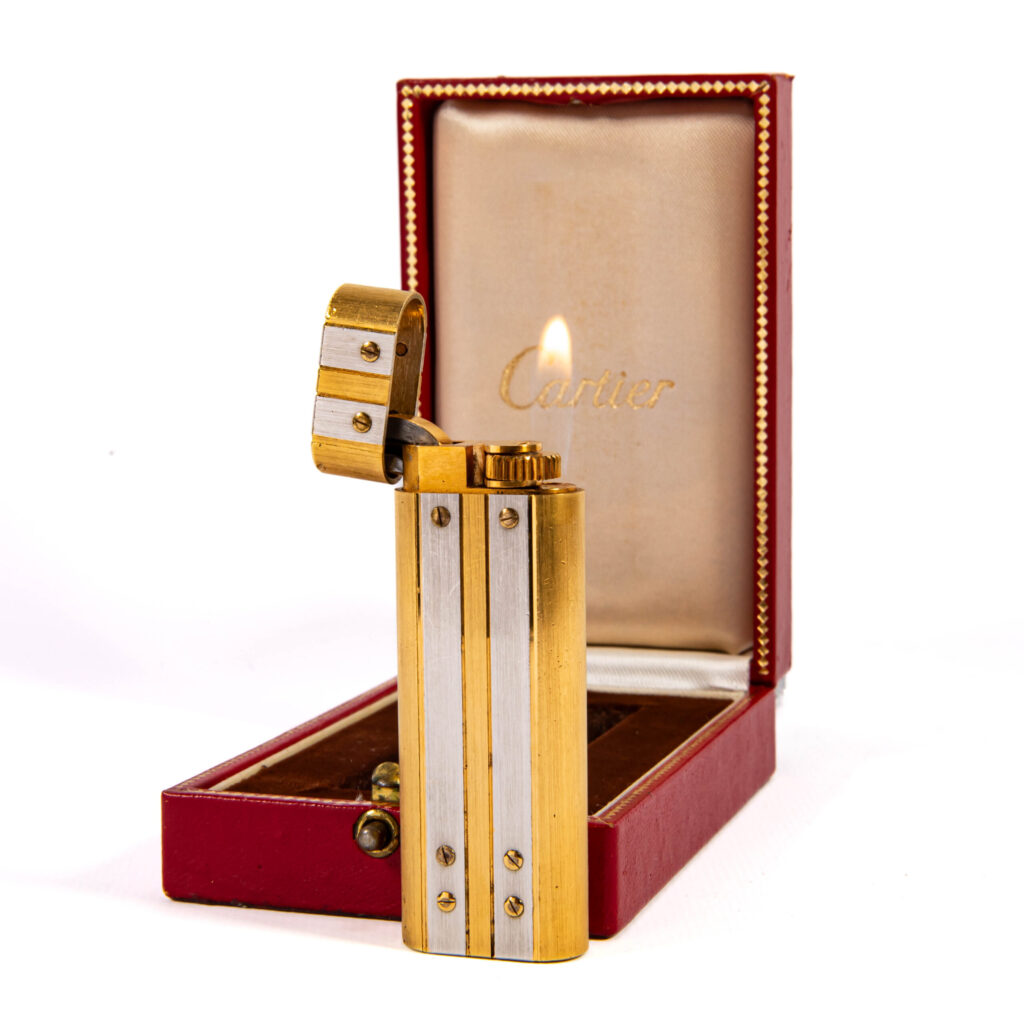
The Santos lighter wears the screw motifs of the Santos watch, which Cartier first made in 1904 for the aviator Alberto Santos Dumont and relaunched in 1978 in steel and gold. On the lighter, brushed silver coloured bands with visible screws run over a gold plated case, so most pieces are two tone. Underneath it is a Les Must.
- Fuel
- Butane and flint
- Size
- 70 × 25 × 12 mm
- Weight
- About 70 g
- Made
- From the late 1970s; most we see are from the 1980s
- Known for
- Screws on cap and body, two tone finish
- In our shop
- Santos lighters
Trinity
The Trinity borrows from the Trinity ring that Louis Cartier designed in 1924, three interlaced bands in three colours of gold. On the lighter the cap is wrapped in three bands, in yellow, white and rose tones, over a case in plate or lacquer, often with the double C logo near the base. Lacquered Trinity lighters, in bordeaux, red, orange and marbled colours, are among the most colourful Cartiers.
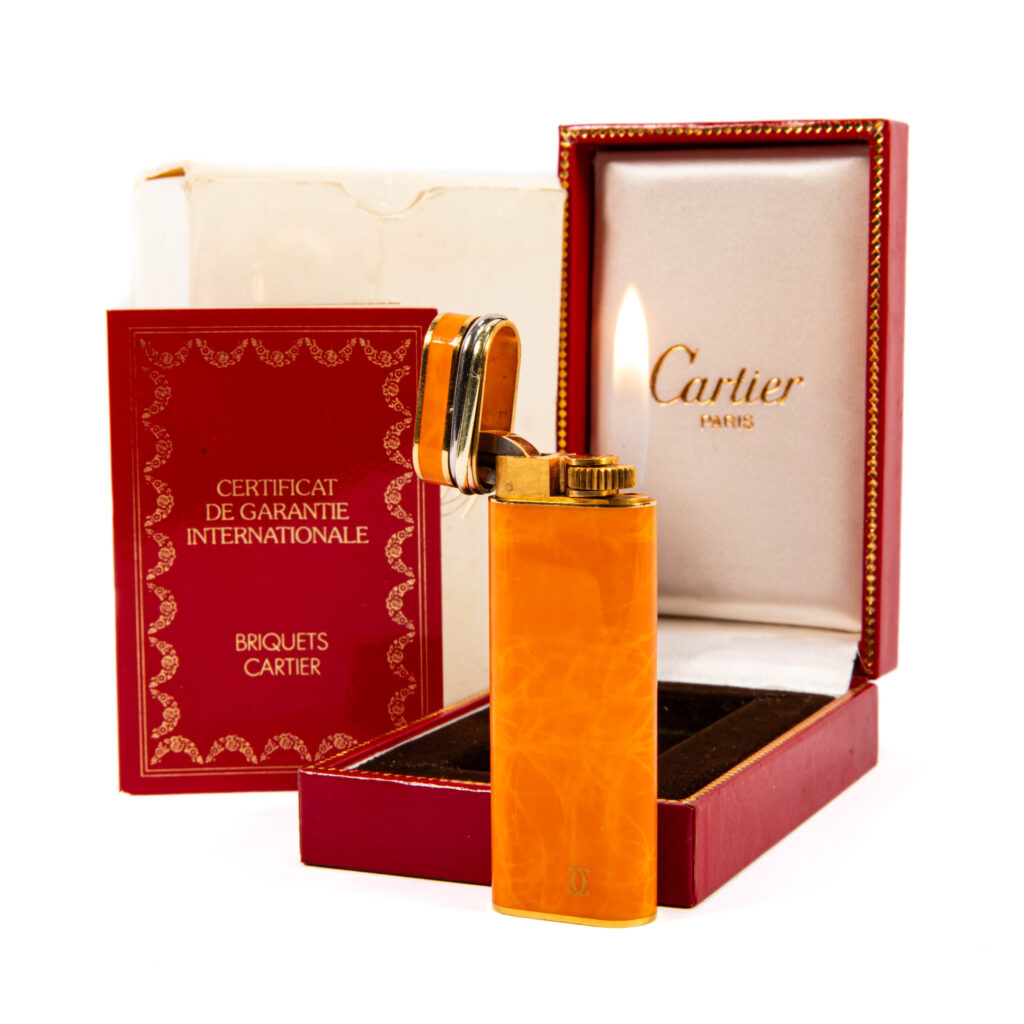
- Fuel
- Butane and flint
- Size
- 70 × 25 × 12 mm
- Weight
- About 73 g in plate; about 87 g in solid 18 carat gold
- Made
- 1970s to 1990s on the pieces we see
- Known for
- Three coloured bands around the cap
- In our shop
- Trinity lighters
Trinity Mini
The short version of the Trinity, with the same three band cap. One of ours from the 1990s has a Panthère decoration, with the spots of the Cartier panther on the cap.
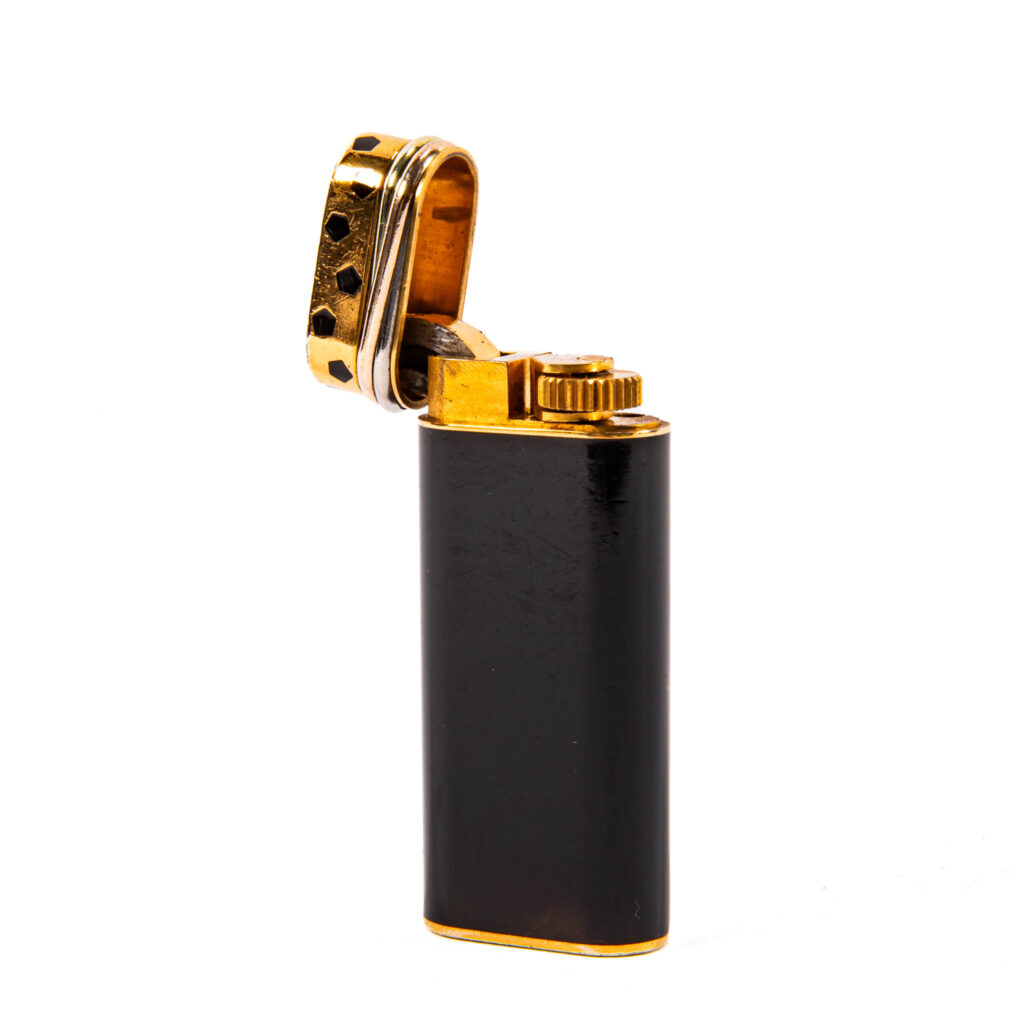
- Fuel
- Butane and flint
- Size
- About 57 × 25 × 12 mm
- Weight
- About 66 g
- Made
- 1990s on the pieces we see
- Known for
- Three band cap on a short case
- In our shop
- Trinity Mini lighters
Pentagon
The Pentagon swaps the rounded case for five flat facets, which give it a crisper, more architectural look and a little more weight. It came in gold and silver plate, brushed or guilloché, and in Chinese lacquer, where the flat faces show the colour beautifully. The edges are where wear shows first, so check them when you buy.
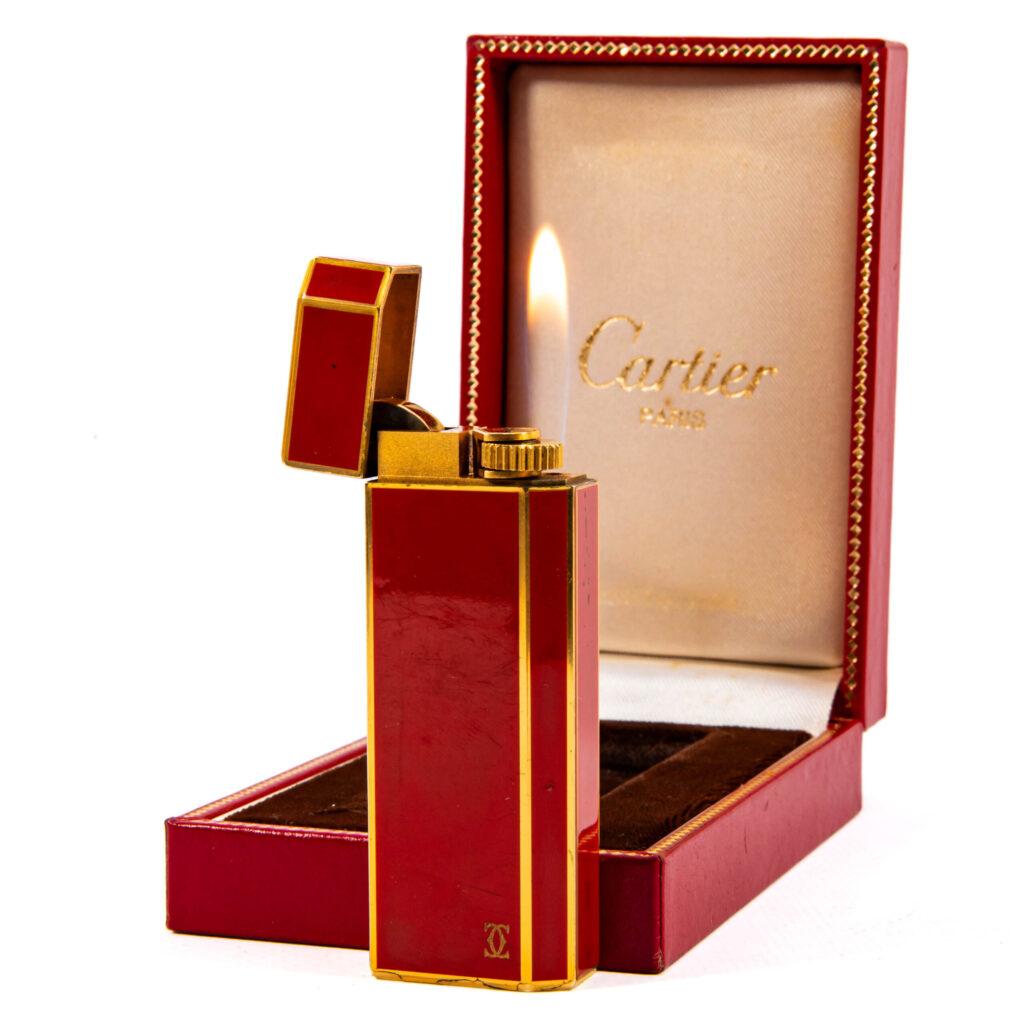
- Fuel
- Butane and flint
- Size
- 70 × 25 × 12 mm
- Weight
- About 94 g
- Made
- 1970s and 1980s on the pieces we see
- Known for
- Five faceted case
- In our shop
- Pentagon lighters
Pentagon Mini
The smallest of the family at about 50 mm tall, yet solid in the hand. We have had them in silver plate and in black and other lacquers.
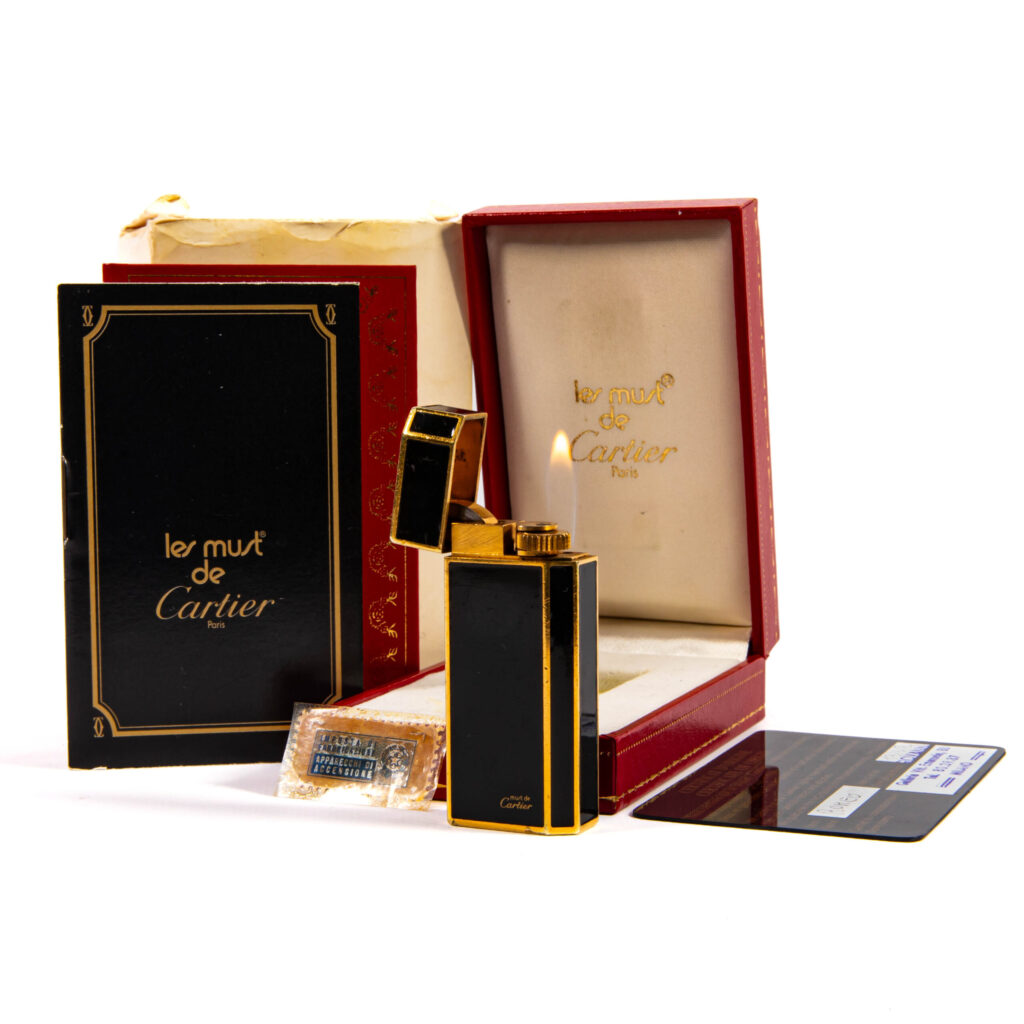
- Fuel
- Butane and flint
- Size
- About 50 × 25 × 12 mm
- Weight
- About 77 g
- Made
- 1970s and 1980s on the pieces we see
- Known for
- The shortest Cartier lighter, five facets
- In our shop
- Pentagon Mini lighters
Oval
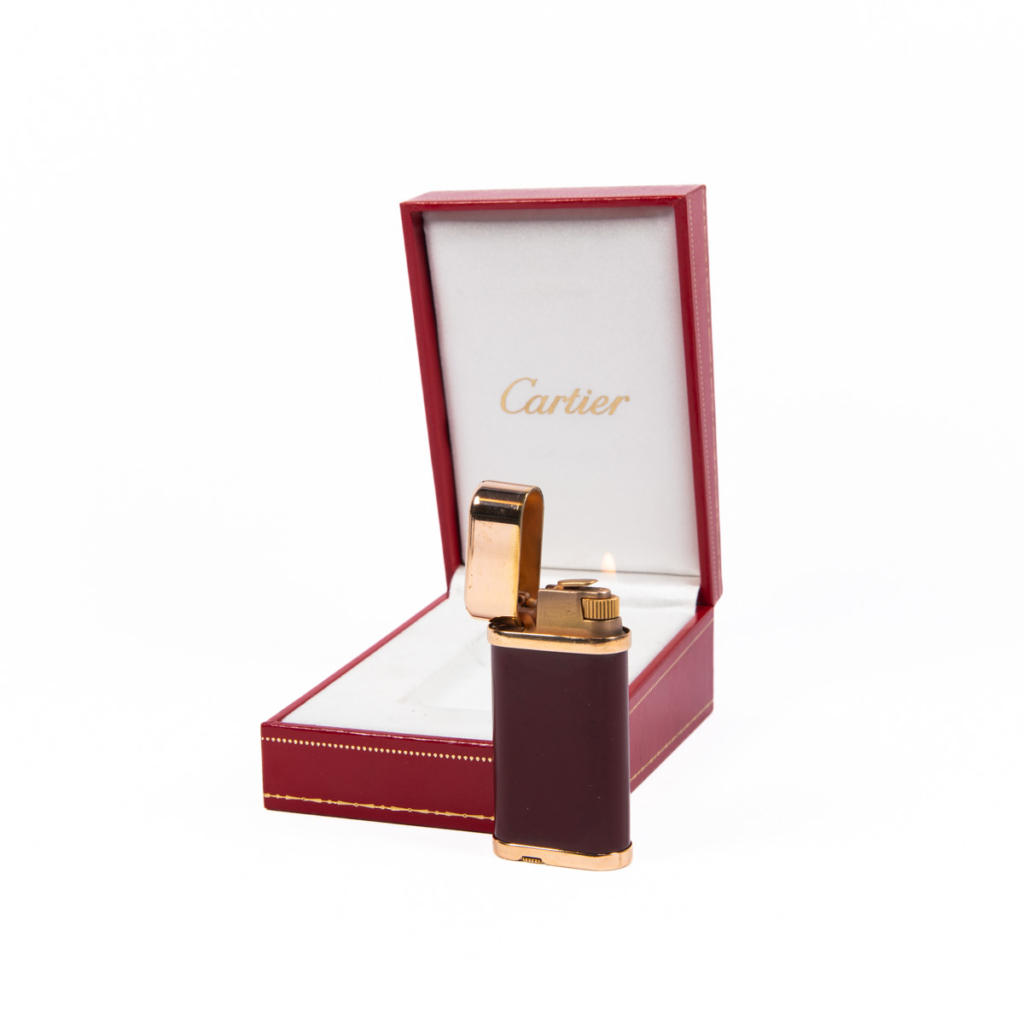
Do not confuse this one with Cartier’s first lighter of 1968, which press histories call “the oval lighter”. We call that first line Les Must, the name on its boxes and papers, and keep the name Oval for this later, Swiss made design: a wider body, a new cap and a burner that sends the flame out sideways, which makes it handy for candles and pipes. The base has a slotted cap over the refill valve, a small flame screw and the words “Swiss made”.
- Fuel
- Butane and flint
- Size
- 60 × 31 × 14 mm
- Weight
- About 50 g
- Base
- Slotted valve cap, separate flame screw, Swiss made
- Made
- Later than the Les Must family
- Known for
- Wider body, sideways flame
- In our shop
- Oval lighters
Les Must Desk and table lighters
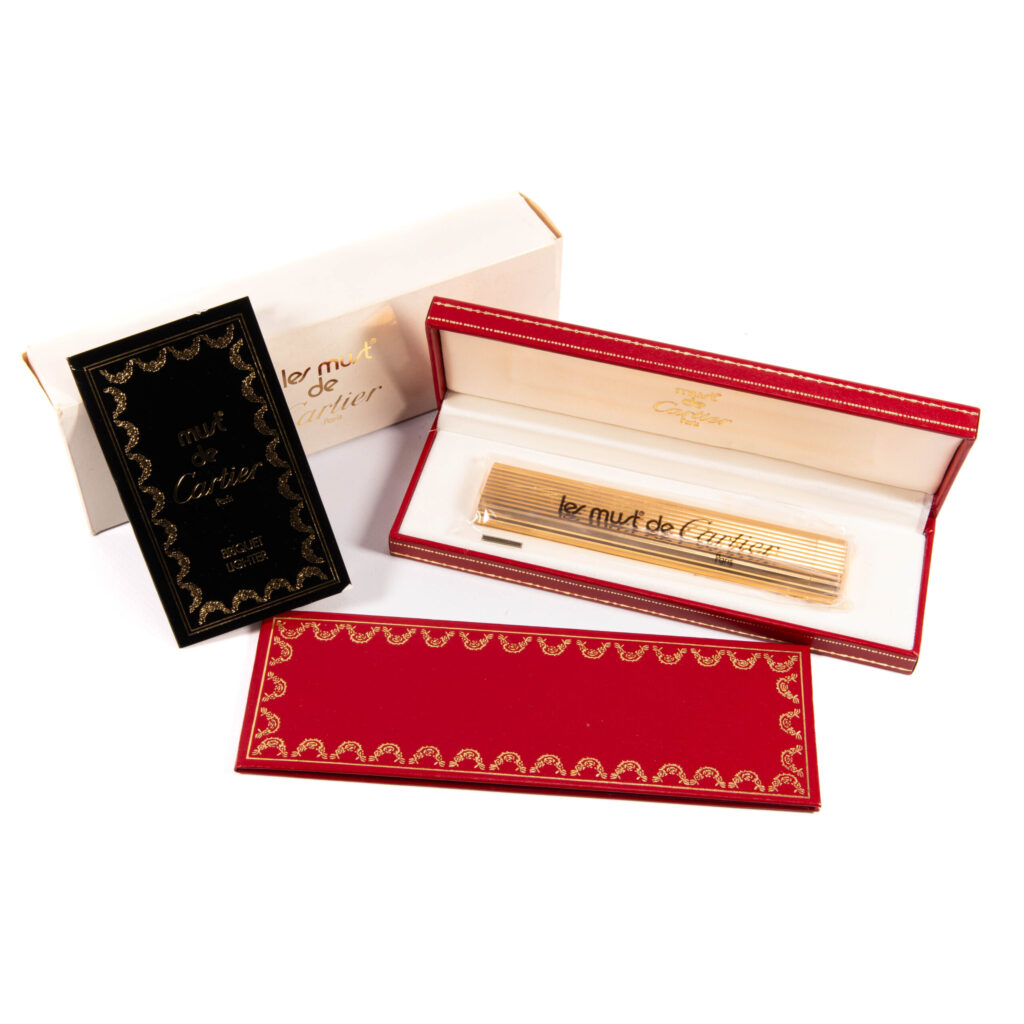
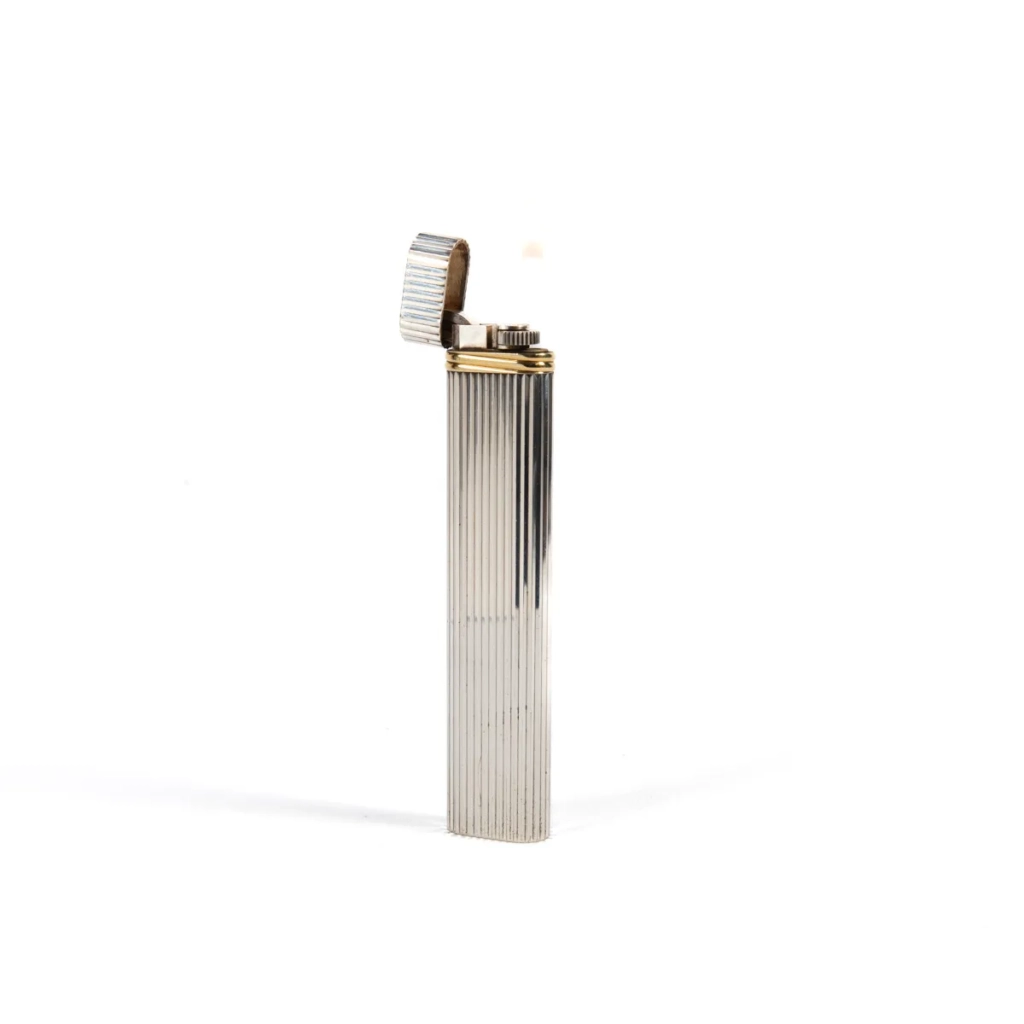
For the desk, Cartier made a tall version of the Les Must, about 124 mm high, with the same oval section and flint mechanism. It stands upright and lights like the small one. Cartier also made heavier table lighters; one we sold, from 1997, was silver plated with a gold plated ring.
- Fuel
- Butane and flint
- Size
- About 124 × 26 × 13 mm, about 102 g
- Made
- 1990s on the pieces we see
- In our shop
- Les Must Desk lighters
Cartier petrol lighters of the past
The gas lighter of 1968 was not Cartier’s first lighter. Long before it, Cartier made petrol lighters, which burn lighter fluid on a wick, in solid silver and solid gold, and some of them have a watch set into the case. They are extremely rare and much sought after by collectors. We once had a square one in solid silver, with a very small cap that lifts up.
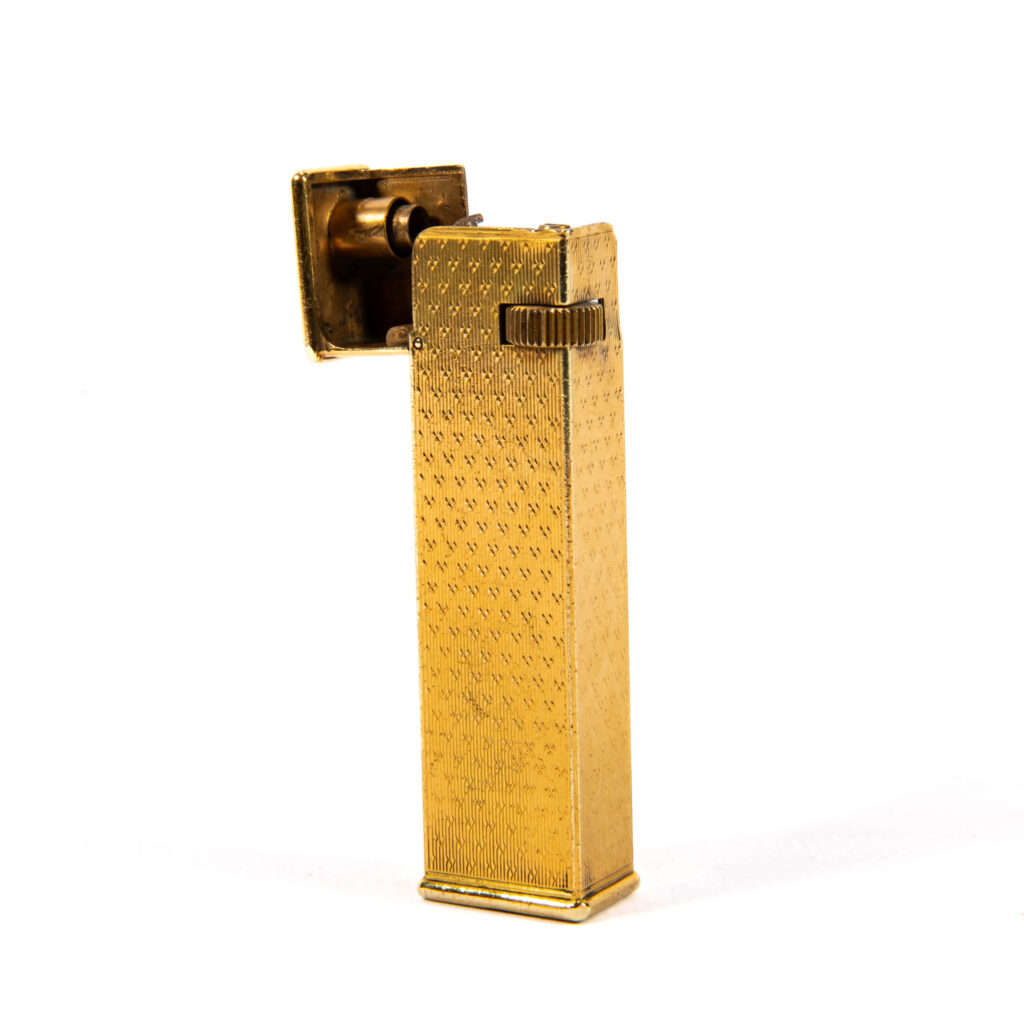
The 1930s lighter we sold as a Dunhill Cartier Licence is a different story: it is a Dunhill lighter, made by Dunhill under Cartier’s licence for the design. We list such pieces under Dunhill as Dunhill Cartier Licence lighters; for Dunhill’s own story, read our history of the Dunhill Rollagas.
- Fuel
- Lighter fluid and flint
- Size
- About 65 × 18 × 12 mm, about 42 g
- Made
- 1930s
- Known for
- A Dunhill lighter, made under Cartier’s licence
What makes a vintage Cartier lighter valuable
- Material. Solid 18 carat gold sits at the top, then sterling silver, then lacquer and plate. A gold or silver jacket over a Cartier is aftermarket work, not Cartier’s own.
- Model and finish. Rare lacquer colours, cabochons, the Pentagon, the first lighters of the late 1960s and Cartier’s old petrol lighters draw the most interest.
- Condition. Plating wears through on edges and lacquer chips are hard to repair, so a crisp case matters.
- Box and papers. The red box and guarantee certificate add to the value, more so on precious metal pieces.
- Working order. A lighter that holds gas and lights well is worth more than one that needs new seals.
Thinking of selling? We buy vintage Cartier lighters, from single pieces to whole collections: see sell your lighter. Collect other houses too? Our guide to every S.T. Dupont lighter model does the same for S.T. Dupont. Or see the vintage Cartier lighters we have now, each one serviced and tested in our workshop.
Vintage Cartier lighters available now
See all Cartier lighters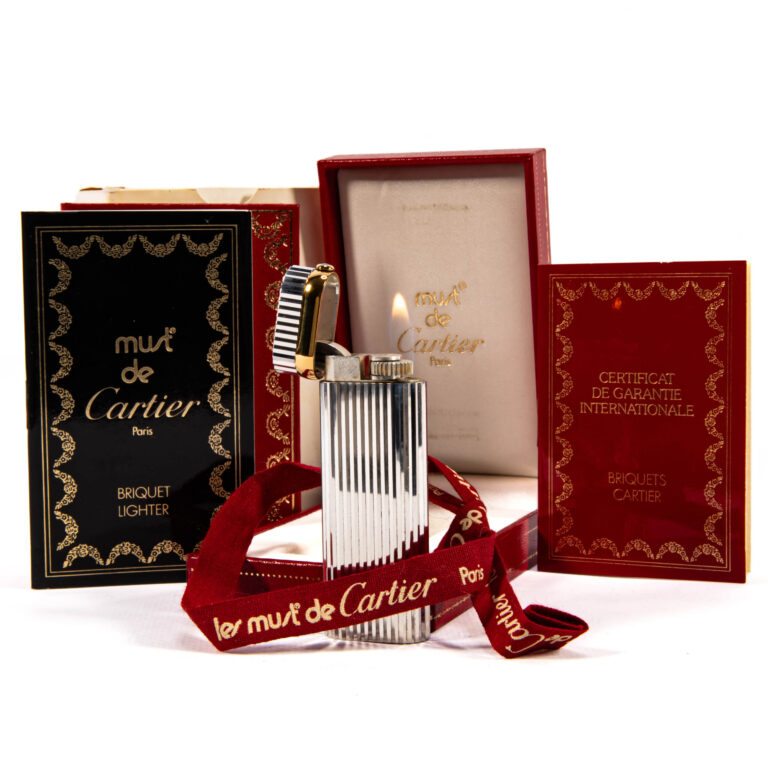
Questions collectors ask
What Cartier lighter models are there?
The vintage models are the Les Must, Les Must Mini, Santos, Trinity, Trinity Mini, Pentagon, Pentagon Mini, the later Oval and the Les Must Desk. Before 1968 Cartier also made petrol lighters in solid silver and gold.
When did Cartier start making lighters?
Cartier's first gas lighter appeared in 1968, made under licence by Robert Hocq's company Silver Match. In 1973 it launched Les Must de Cartier.
How do I know which Cartier lighter I have?
Look at the case and measure it: screws mean a Santos, a three band cap a Trinity, five flat facets a Pentagon, and a plain or patterned oval a Les Must. About 70 mm tall is full size; shorter means a mini.
Can you date a Cartier lighter by its serial number?
Not on its own: we know of no published key. Early pieces tend to have five digit numbers, later ones add letters, but the style, the box and the papers tell you more. We are collecting serials with dated papers to change that: send us yours.
How can I tell if a Cartier lighter is real?
Check the base for sharp, clean Cartier Paris engraving, a metal mark and a serial number, then the weight, size and a smooth hinge. Not sure? Send us photos and we will take a look.
What is a vintage Cartier lighter worth?
It depends on the material, model, condition and whether the box and papers are there: solid gold is worth far more than plate. See what we have in our Cartier collection, or ask us for a valuation.
Sources and further reading
- Fondation Haute Horlogerie: Indestructible Cartier the oval lighter of 1968, licence to Silver Match, Perrin at Briquets Cartier, the Fribourg factory
- WatchPro USA: Cartier's colourful past and present Hocq's licence for the oval lighter in 1968, gold plated, Cartier packaging
- WatchProSite: Cartier and Richemont, the lighter's legacy fluted gold plated first lighter, Les Must de Cartier in 1973
- Wikipedia: Cartier (jeweler) Les Must de Cartier 1973, Santos relaunched 1978
- Cartier: Santos de Cartier square lighter Cartier still makes lighters today, with the Santos screw motif
- Opulent Jewelers: Cartier Trinity the Trinity designed by Louis Cartier in 1924