The Patek Philippe Golden Ellipse Lighter: A Collector’s Guide to the Rarest Lighter in Watchmaking

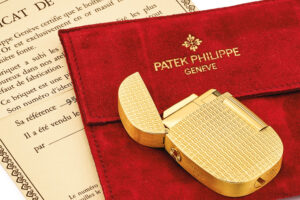
Patek Philippe is not a name you expect to find on a lighter. The Geneva manufacture has spent nearly two centuries building a reputation around watches, and almost nothing else in its catalogue carries the same gravity. But for a brief period in the late 1970s and early 1980s, Patek produced one of the most curious objects in its entire history: a solid gold pocket lighter, shaped like the Golden Ellipse watch, sold through the same retail network as the watches themselves, and made in numbers so small that fewer than fifty examples are documented today.
This is a guide to those lighters. It covers where they came from, who actually made them, how to identify a genuine example, and why they have become one of the most quietly sought-after objects in the wider Patek Philippe collecting world.
The Golden Ellipse: From Watch to Family
To understand the lighter, you have to understand the watch. The Golden Ellipse was introduced in 1968 as the reference 3548, Patek Philippe’s first new collection since the Calatrava launched in 1932. Its case was based on the golden ratio (1:1.6181), the proportional principle studied by ancient Greek mathematicians and applied across Western art and architecture for two and a half thousand years. The result was a watch shape that sat between a circle and a rectangle, instantly recognisable, and deliberately distinct from everything else in the Patek catalogue.
The Golden Ellipse was a commercial success. By the end of the 1970s, Patek had developed it into a full family with as many as sixty-five different references. The shape was distinctive enough that Patek treated it less as a single watch and more as a design language, applying it to cufflinks, key fobs, signet rings, and eventually pocket lighters. John Reardon, the leading public expert on Patek Philippe and former head of Patek at Christie’s, has described the Ellipse as the first time Patek created a product line of accessories around a single shape.
The lighter was the most ambitious of these accessories, and the one furthest from the brand’s core business.
The Lighters Themselves
.jpg?mode=max)
Patek Philippe Golden Ellipse lighters were produced between roughly 1977 and the early 1980s, in 18-carat yellow gold, 18-carat white gold, and translucent enamel over hand-engraved gold. Across the run, six core references were offered.
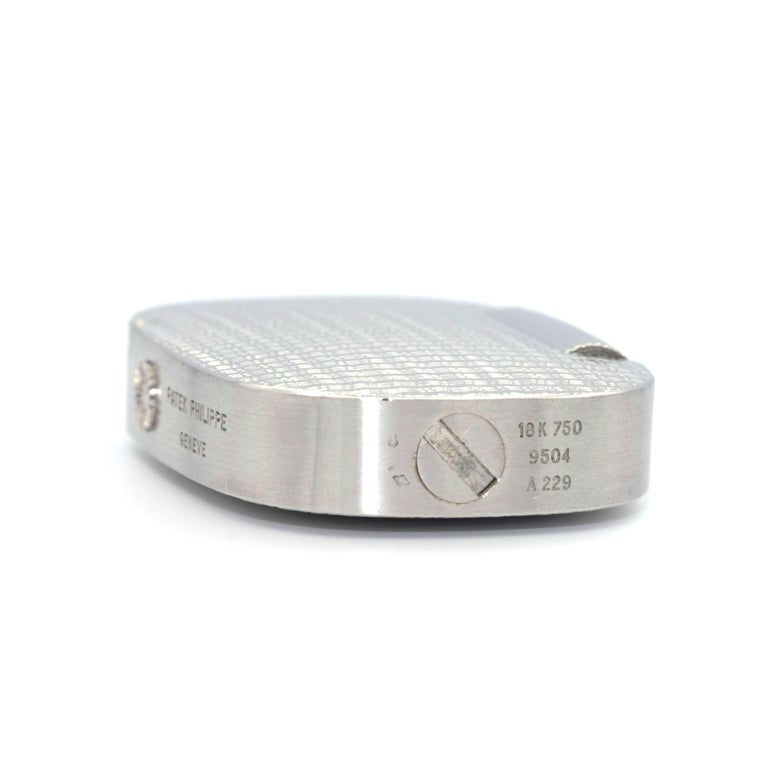
The solid gold references comprised the 9502 Louis-Philippe (named for a côtes de Genève striped pattern), the 9504 Ocean (a woven basket-weave pattern), and the 9505 Chevrons (a chevron pattern cut with a rose engine). The enamel references were the 9506 Red, the 9507 Blue, and the 9508 Green, each one finished with translucent vitreous enamel applied over a hand-engraved barleycorn (grain d’orge) pattern that catches the light through the colour. The enamel pieces are the rarest of the standard production references.
All examples share the elliptical case shape of the watch, and crucially, the surfaces are not flat. A Patek Philippe advertising brochure from the late 1970s explains the choice in the brand’s own words: “The flat surfaces of ordinary lighters can be engine-turned industrially. For Patek Philippe this is inconceivable; not only as a matter of principle, but also because the Patek Philippe lighter has a convex surface to underline the Golden Ellipse shape and fits more snugly into the palm. Texturing the lighter therefore requires hand-operated equipment — rose-engines from the 19th century.”
The use of antique rose engines is the same technique used to produce the guilloché dials and case decorations on Patek’s most exceptional watches. It is slow, hand-controlled work, and on a convex gold surface it requires a specialist hand.
The Colibri Question
One detail about the Golden Ellipse lighter that Patek Philippe does not advertise, but which is now well established among specialist collectors, concerns who actually built the mechanism. The lighters were not made from the ground up in Geneva. The mechanical lighter element — the gas valve, the flame regulator, the ignition system, the hinge — was supplied by Colibri, a specialist British lighter manufacturer with production facilities in France. Patek finished the exterior, applied the guilloché and enamel work, hand-checked and polished each mechanism, and signed and numbered each finished piece. But the underlying lighter was Colibri.
Sotheby’s catalogues reference this directly, noting that “the lighters were most probably commissioned by Patek Philippe from the specialist lighter manufacturer Colibri.” Alan Bedwell, the vintage accessories specialist behind Foundwell, has been even more direct, telling A Collected Man that Colibri “supplied the lighter element” and describing the firm as “a very average maker” by comparison with the higher-quality lighter Maisons of the period such as S.T. Dupont, Dunhill, and Caran d’Ache. Bedwell has also said he has heard “negative stories about the Golden Ellipse from a functioning perspective,” noting that the Colibri-supplied mechanism is the weak point of an otherwise extraordinary object.
This is, in some ways, the same story as the great Parisian jewellery Maisons commissioning specialist ateliers like Pierre G. Brun to handle gold work that fell outside their own production capabilities. Patek Philippe is a watch manufacture, not a lighter manufacture, and at the moment they decided to put a Patek-signed lighter into the market, the obvious choice was to source the mechanical core from someone who already knew how to build one. Of historical curiosity, Colibri is also the firm that produced the gold pieces used to assemble the famous golden gun prop in the 1974 James Bond film The Man with the Golden Gun.
The Patek elements of the lighter, however, are exceptional. The exterior gold work, the rose-engine guilloché, the enamel, and the hand-finishing are all done to Patek Philippe standards, and an Ellipse lighter held in the hand reads unmistakably as a Patek object regardless of who supplied the gas valve.
The Sultan of Oman Commissions
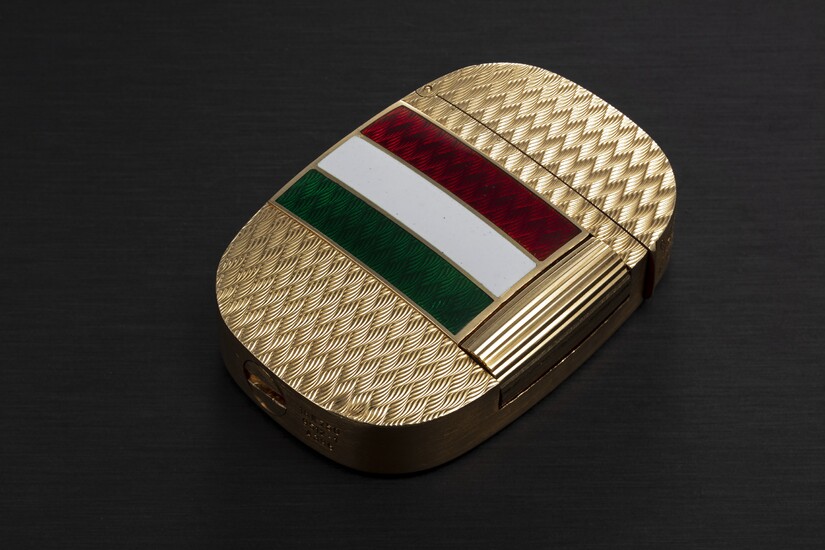
The most coveted Golden Ellipse lighters are the bespoke pieces produced on commission for Sultan Qaboos bin Said al Said of Oman. Qaboos was a passionate watch collector who commissioned bespoke timepieces from Patek Philippe, Rolex, Audemars Piguet, and others throughout his reign (1970-2020), most of them stamped with the Khanjar — the curved dagger over crossed swords that became Oman’s national emblem after the country’s founding in 1970. These pieces were used as diplomatic gifts to foreign dignitaries, officials, and loyal staff, and they form one of the most distinctive sub-categories in vintage Patek collecting.
The Ellipse lighters made for Qaboos carry a separate reference number, 9512-1, and are finished in translucent enamel over a chevron pattern with the Khanjar applied to the cap. Only a handful are known to have surfaced publicly. Phillips sold one at auction in Geneva in November 2020 for close to £42,000, which remains among the highest documented prices for a Patek Philippe lighter of any kind.
How to Identify a Genuine Example
A genuine Patek Philippe Golden Ellipse lighter carries several consistent markings. The brand name is engraved as “PATEK PHILIPPE” on the case. The gold marks include the 18k stamp and the 750 fineness mark, alongside two additional hallmarks confirming the Swiss assay. The four-digit reference number begins with 95 (9502, 9504, 9505, 9506, 9507, 9508, 9512-1). The individual serial number begins with the letter A followed by three digits.
The serial system is consecutive, and the highest known A-prefixed numbers fall within the range consistent with a total production of between one hundred and two hundred lighters. Reardon’s estimate, based on factory records and known examples, is that approximately one hundred to two hundred lighters were produced in total, with around thirty publicly documented as of 2021. The Phillips and A Collected Man estimates run slightly higher, putting the total at perhaps three to four hundred. The truth is probably somewhere in that range, and either way the lighters are exceptionally rare.
Surviving examples typically weigh around ninety grams or more in solid 18-carat gold. Original presentation included a fitted box, a certificate, and in some cases a matching pair of Golden Ellipse cufflinks.
Pricing and Market Context
Original retail prices in the early 1980s were 5,800 USD for the standard solid gold references and 8,000 USD for the enamel versions. For comparative scale, in 1985 the Patek Philippe reference 2499/100J — one of the most legendary perpetual calendar chronographs ever produced — retailed for 22,000 USD. The lighter was, in other words, priced at roughly one-quarter of a 2499, which gives a sense of where it sat in the Patek hierarchy.
Today, depending on reference, condition, and the presence of original box and certificate, Golden Ellipse lighters generally trade in the range of fifteen to twenty-five thousand euros for standard solid gold examples, with enamel references and Khanjar-engraved pieces commanding multiples of that figure. The Phillips Oman Khanjar example at £42,000 remains the headline result.
In Summary
The Patek Philippe Golden Ellipse lighter is a curiosity, an outlier in a catalogue otherwise devoted entirely to mechanical watches, and a fascinating example of what happens when a great manufacture decides to apply its design language to a category it does not actually produce in-house. The lighters were finished to Patek Philippe’s own exacting standards on the outside and built on a Colibri mechanism on the inside, and the resulting object has become one of the most quietly significant collectibles in the wider Patek world.
For collectors who care about lighters first and watches second, the Golden Ellipse is also a fascinating cross-over object. It belongs in a conversation with the solid gold S.T. Dupont catalogue of the same period, with Cartier’s high-end lighters of the 1970s, and with Dunhill’s gold work. It is rarer than any of them, signed by a name that almost nobody associates with lighters at all, and built around a shape that has barely changed in nearly sixty years.
Sources:
John Reardon for Collectability, “The ‘Golden Ellipse’ Lighter”; A Collected Man, “The curious case of the Patek Philippe Golden Ellipse lighter” (interview with Alan Bedwell of Foundwell and Alexandre Ghotbi of Phillips); Sotheby’s auction catalogues 2019 and 2021; Phillips Geneva Watch Auction XII catalogue; Patek Philippe official Golden Ellipse heritage materials; Revolution Watch on the Omani commissions.