S.T. Dupont Solid Gold Lighters: The ‘Or Contrôlé 18 Carats’ Collection Explained
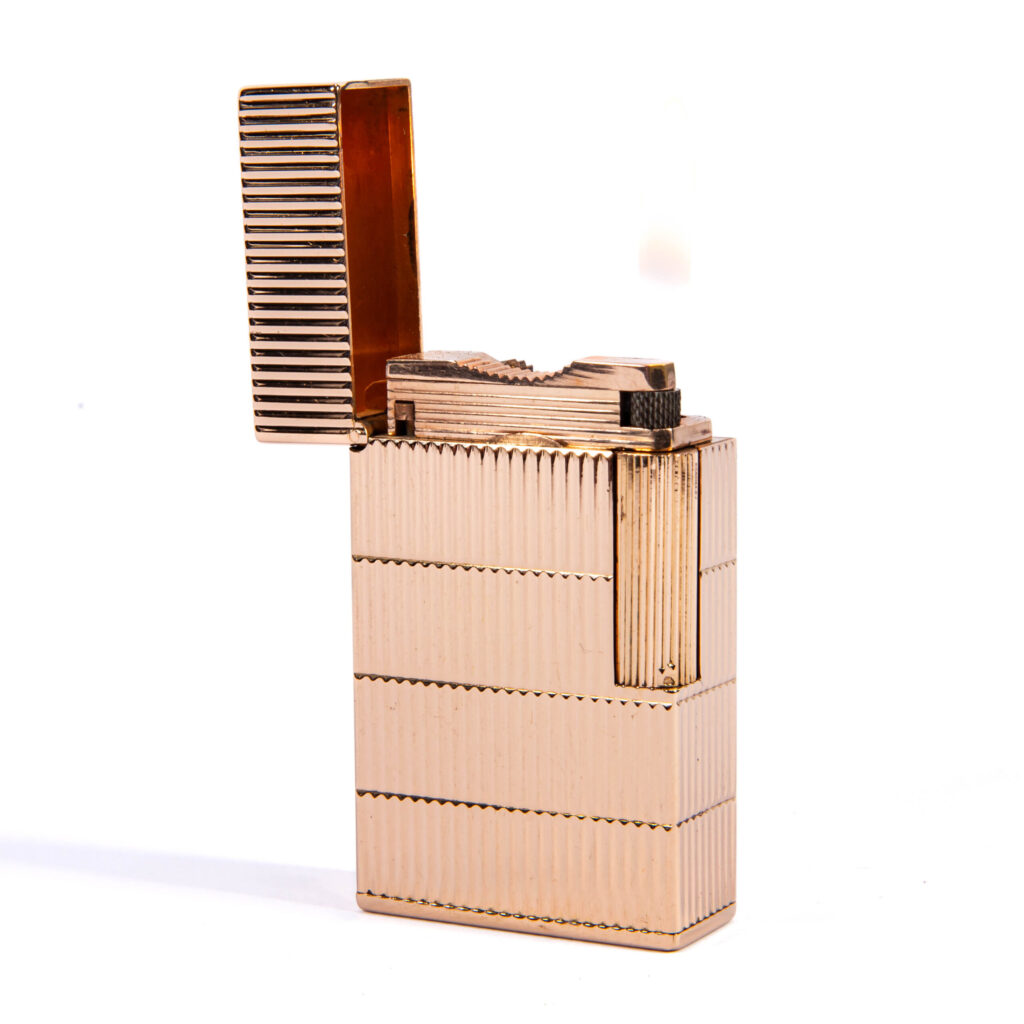
Among vintage S.T. Dupont lighters, the solid 18-carat gold pieces sit in a category of their own. They are noticeably heavier than plated examples, they are hallmarked like fine jewellery, and they were sold at roughly ten times the price of their gold-plated equivalents. This guide explains what these lighters actually are, how to identify a genuine one, and what to look for as a collector. All vintage Dupont lighters offered by The Lighterhouse are 100 percent guaranteed authentic.
A Royal Commission Started It All
S.T. Dupont was a leather-goods house for nearly seventy years before making its first lighter. The shift happened in 1941, when Yadavindra Singh, the Maharaja of Patiala, commissioned a series of lacquer minaudière evening bags and stipulated that each one had to contain a matching pocket lighter in solid gold. The Tissot-Dupont brothers took the order, and in doing so launched what would become one of the defining product lines in the history of French luxury.
This commission established S.T. Dupont as a maker of solid gold lighters, and the Maison’s Prestige and Haute-Création lines continue to produce solid gold pieces on commission today.
"Orfèvres à Paris": How Dupont Positioned the Gold Work
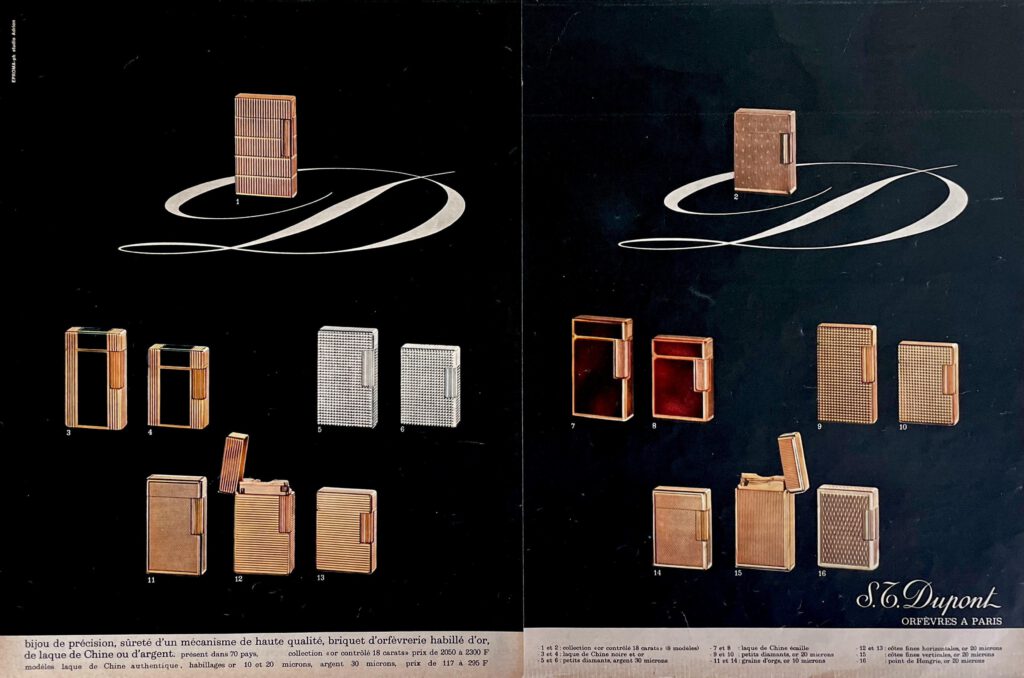
A 1964 S.T. Dupont advertisement makes the positioning explicit. The Maison signs itself off as “Orfèvres à Paris” — Paris goldsmiths — and presents what it calls the collection «or contrôlé 18 carats», an eight-model range of solid 18-carat gold lighters. The ad lists prices from 2,050 to 2,300 francs for the solid gold models, against 117 to 295 francs for the gold-plated equivalents. The premium for solid gold was roughly tenfold.
The term or contrôlé is the formal French designation for gold that has passed through an official assay office and received the state guarantee of fineness. It is not a marketing phrase. It is a legal status, and a Dupont lighter described as or contrôlé 18 carats in period documentation was, by definition, a piece that carried the eagle’s head poinçon.
This 1964 ad is also the clearest evidence that solid gold Duponts were never a one-off bespoke programme. They were a formal catalogue collection, made in known patterns, sold at known prices, and intended for a defined market segment.
The Patterns Dupont Used on Gold
The same advertisement names the engine-turned patterns Dupont used on its lighters in French, primarily in reference to the gold-plated range. The same vocabulary is broadly applicable to the solid gold examples, which were finished using related techniques.
The graine d’orge (barleycorn) pattern is the most classic: fine vertical lines running parallel from base to lid, giving the lighter its characteristic refraction.
The côtes fines verticales and côtes fines horizontales are vertical and horizontal ribbed patterns.
The point de Hongrie (Hungarian point, or herringbone) is a chevron-style pattern.
The honeycomb or hexagonal pattern is one of the most sought-after treatments and is associated with early vintage production.
Plain polished gold examples also exist and occasionally surface with personalised engraving such as initials, dates, or monograms.
Reading the Hallmarks
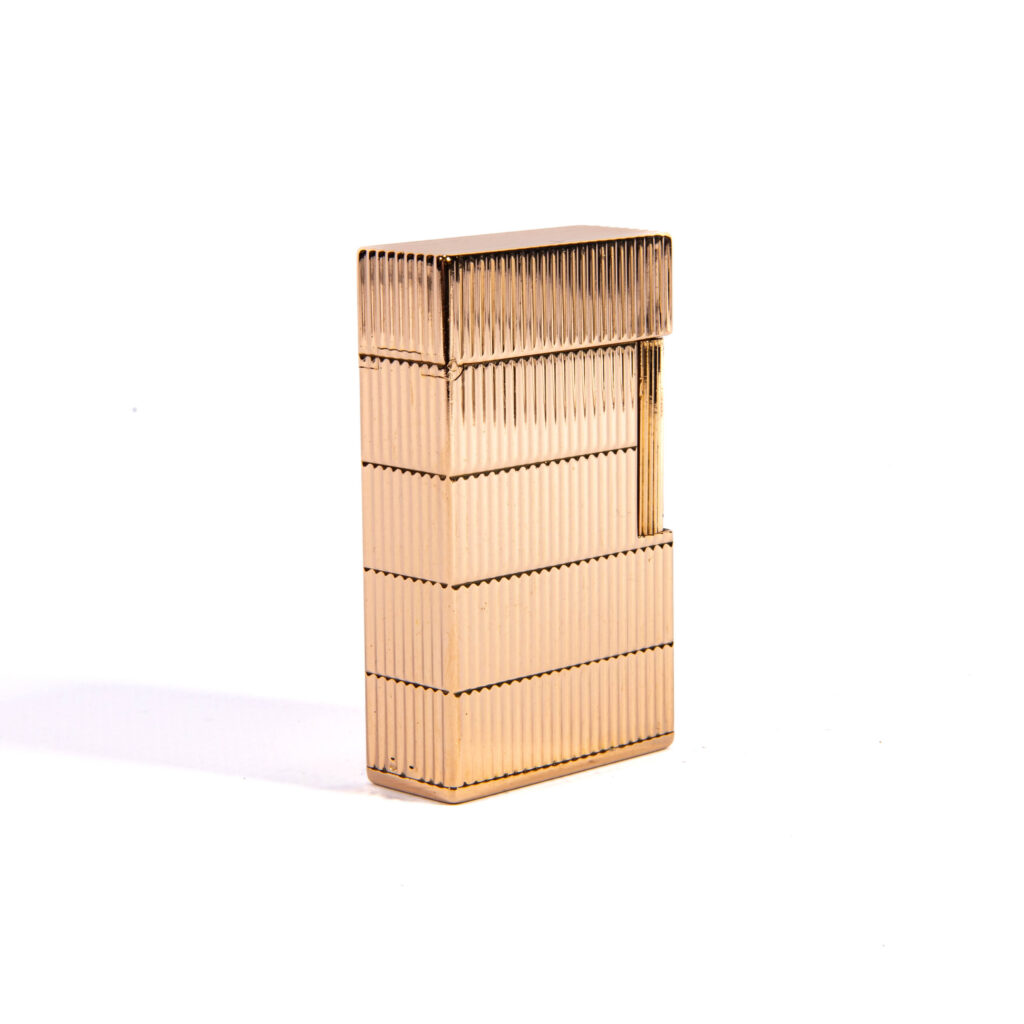
A genuine solid gold Dupont will carry a combination of marks struck multiple times across the body. The standard cluster is as follows.
The eagle’s head poinçon is the French state guarantee of 18-carat (750/1000) fineness, applied since 1838. Before 1994, this mark could only be struck by civil servants at the official assay office. Any vintage Dupont gold lighter without an eagle’s head should be treated with extreme caution.
The 18 KTS or 750 fineness mark restates the gold content. Both forms are encountered on vintage Dupont gold lighters.
The maker’s mark — the poinçon de maître — is a lozenge-shaped punch unique to the workshop that produced the piece. On Dupont gold lighters this mark is often combined with a serial number, sometimes shown as a letter followed by digits.
The S.T. Dupont signature itself appears separately from the official marks. The signature confirms the brand; the eagle’s head and maker’s mark confirm the metal and the workshop.
On a solid gold Dupont, the hallmarks are typically repeated across multiple locations on the body, including the back, the dial, the inside of the lid, and the base. On some examples even the bottom screw is solid gold and individually hallmarked, which is one of the most distinctive authentication tells, since a plated lighter has no reason to carry a hallmark on a hidden component.
Weight as a Confirmation
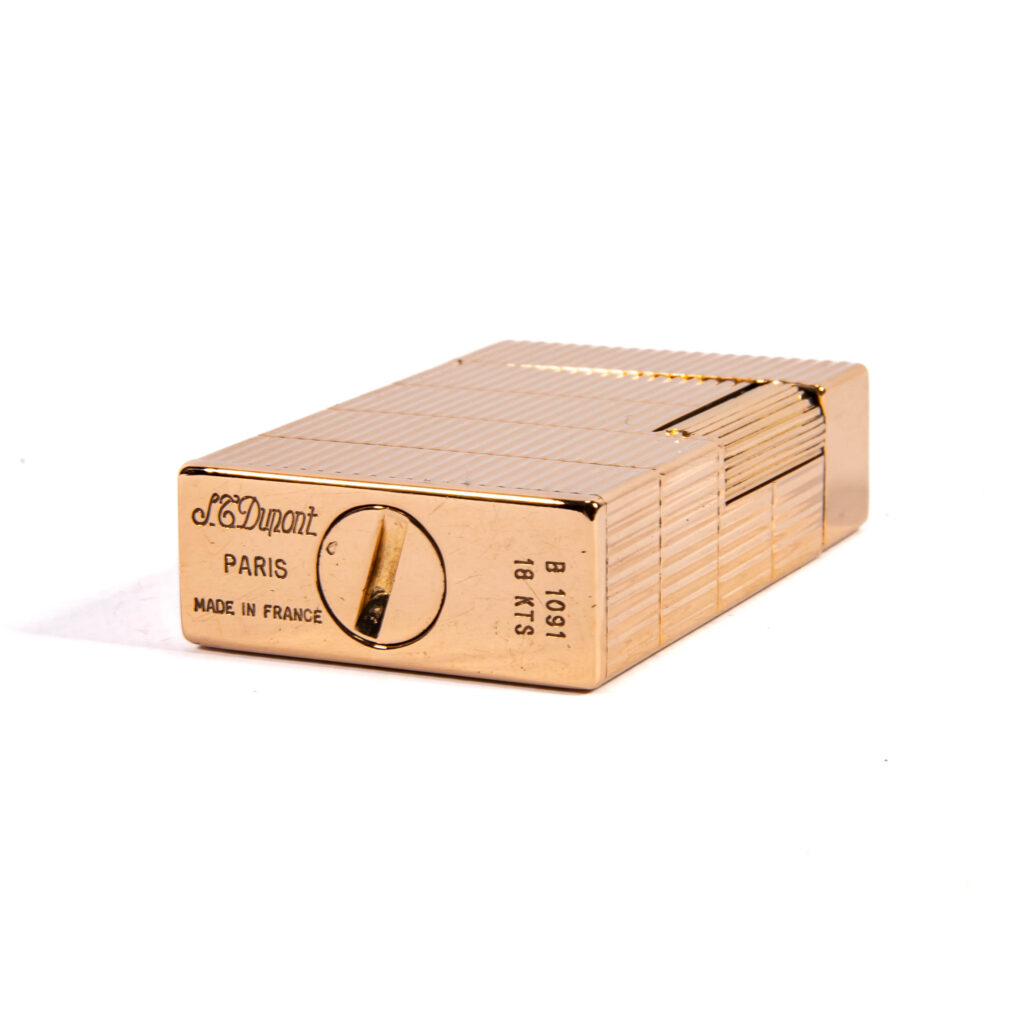
There is no substitute for putting a solid gold lighter on a scale. Gold is roughly two and a half times denser than brass at the same volume, and the difference is immediately obvious in the hand.
A solid 18-carat gold Ligne 1 large will typically weigh between 115 and 135 grams. A solid gold Ligne 2, which is dimensionally smaller, will sit noticeably lower. A lighter claiming to be solid gold but weighing significantly below the expected range for its model should be treated sceptically until the hallmarks are verified.
A Note on the Paris Workshops
S.T. Dupont’s “Orfèvres à Paris” positioning was not purely symbolic. Producing a fully hallmarked solid gold lighter requires goldsmith-grade tooling, official assay office presentation, and the application of a registered poinçon de maître. In the historical pattern of French luxury, exceptional gold pieces for the great Maisons were often produced in collaboration with specialist Parisian ateliers who held their own master’s marks.
Among collectors, the workshop of Pierre G. Brun (founded 1936, sold to Cartier in 2000) is sometimes mentioned in connection with early Dupont gold lighters, based on hallmark formats and collector testimony. The Brun workshop’s published client list includes Cartier, Van Cleef & Arpels, Boucheron, Bulgari, Chaumet, and Asprey, but not Dupont, so this remains a collector hypothesis rather than a documented attribution. What is certain is that the gold work passed through Paris-registered goldsmith infrastructure, regardless of which specific atelier was involved on any given piece.
What to Check Before Buying
If you are considering a vintage solid gold S.T. Dupont, the priorities are clear. The hallmarks must be present, complete, and consistent across the expected locations. The weight must match the model. The engine-turning should be crisp, not soft. The hinge should retain the unmistakable Dupont “cling” when the cap closes. A hallmark on the bottom screw, where present, is an especially strong indicator of authenticity.
Pricing for vintage solid gold Duponts is driven by condition, completeness (original box and papers), engine-turning pattern, the visibility of the maker’s mark, and provenance. The rarest configurations in full set with original documentation can comfortably enter five-figure territory in euro.
In Summary
Solid gold S.T. Dupont lighters were a formal catalogue range, not a series of one-off curiosities. They were marketed by the Maison as the work of Paris goldsmiths, produced in named patterns, hallmarked to French assay standards, and sold at a significant premium over the plated production.
At The Lighterhouse, every vintage S.T. Dupont we handle is individually weighed, hallmark-verified, and serviced where necessary by specialists. If you own a solid gold Dupont and want to understand what you are holding, or are considering acquiring one, please get in touch.
Note: This comparison is based on general characteristics of each brand’s iconic models. Individual condition and edition may vary.